Gold investment insights from Peter Schiff, a renowned economist and staunch advocate of gold investment, offer a compelling perspective on the strategic value of physical gold in today's volatile economic landscape. Emphasizing its historical resilience, Schiff champions gold as a hedge against inflation and currency devaluation, forecasting substantial price increases. His predictions, which suggest gold could surpass $5,000 per ounce, are rooted in concerns over escalating global debt and the fragility of fiat currencies.
Nevertheless, Schiff's unwavering focus on gold has sparked debate among financial experts about investment diversification and alternative assets. Could these insights reshape your investment strategy? Some argue that Schiff's emphasis on gold may lead to a lack of diversification in one's investment portfolio, which could ultimately result in heightened risk. On the other hand, others believe that his expertise in the gold market offers a unique perspective on alternative assets that may be worth considering. Regardless of where you stand on the issue, it is important to weigh the pros and cons of gold investment advice from Peter Schiff before making any significant changes to your investment strategy.
Our Quick Summary
- Peter Schiff views physical gold as a critical hedge against inflation and economic instability.
- Due to currency devaluation and geopolitical risks, Schiff predicts gold prices could surpass $5,000 per ounce.
- He emphasizes the importance of gold for wealth preservation and portfolio diversification.
- Schiff's investment strategy includes a significant allocation to gold and silver mining stocks.
- He advocates for physical gold storage and investment in gold-focused funds for stability during financial crises.
Peter Schiff's Background

Peter Schiff is a distinguished American economist, financial commentator, and author renowned for his contrarian perspectives on the U.S. economy and monetary policy.
As CEO of Euro Pacific Capital Inc. and founder of SchiffGold, Schiff's gold investment philosophy is deeply rooted in his belief in the value of precious metals.
He gained prominence by accurately predicting the 2008 financial crisis, significantly improving his reputation.
Influenced by the Austrian School of Economics, Schiff emphasizes sound money principles and advocates for tangible assets to safeguard against the impact of flawed monetary policies.
Through his Peter Schiff Show Podcast, he continues to analyze economic data and provide insights into wealth preservation and investment strategies.
Importance of Physical Gold
The importance of physical gold in an investment portfolio cannot be overstated. As a gold investment advice, owning physical gold acts as a critical inflation hedge, preserving its essential value against economic instability and currency devaluation.
Historical evidence showcases gold as a safe haven asset, resilient during financial crises and economic downturns. Furthermore, physical gold's tangible nature protects against market volatility and fiat currency erosion.
Given its low correlation with other asset classes, physical gold enhances portfolio diversification and reduces overall risk exposure. Unlike fiat currencies, physical gold retains purchasing power during inflationary periods, making it a wise addition to any investment strategy focused on long-term stability and risk management.
Benefits of Gold Investment
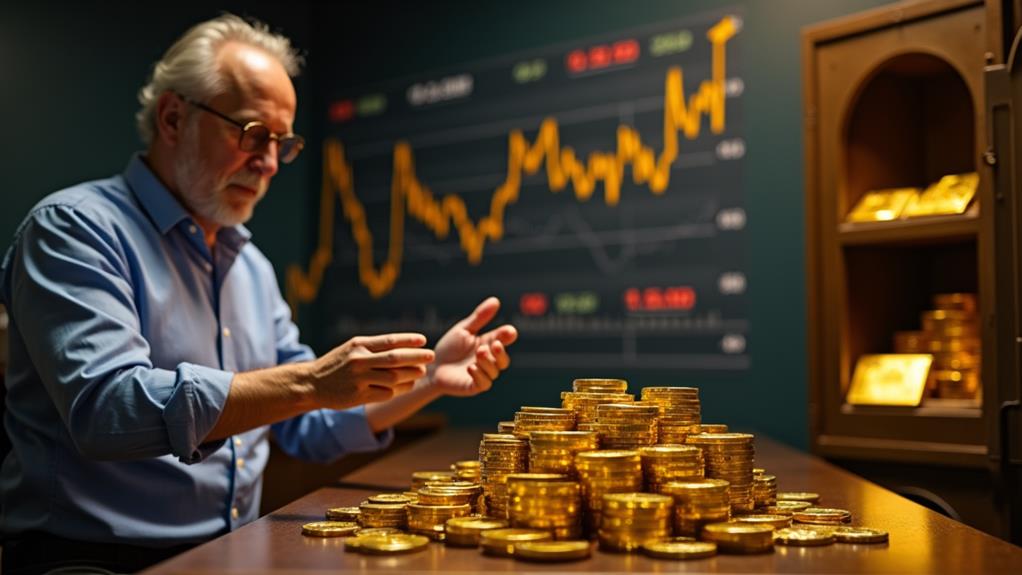
Gold investment offers many benefits, making it an attractive asset for seasoned and novice investors.
Gold investment insights from Peter Schiff highlight that gold is a hedge against inflation, maintaining purchasing power and acting as a reliable store of value during economic uncertainty. Historical data shows gold's consistent appreciation during economic downturns, enhancing wealth preservation.
Given its low correlation with stocks and real estate, incorporating gold into a portfolio can enhance diversification. Unlike fiat currencies, gold retains inherent value over time, safeguarding against currency devaluation.
Investing in gold through physical holdings or mining stocks offers the potential for long-term financial security and stability during market volatility. The gold price forecast remains optimistic, reinforcing its role as a strategic asset.
Fiat Currency and Monetary System
Concerns about currency devaluation are at the forefront of discussions about fiat currency, with critics like Peter Schiff highlighting the instability fundamental in systems dependent on government backing.
He argues that excessive money printing by the Federal Reserve undermines the value of the U.S. dollar, leading to significant erosion of purchasing power over time.
Advocating for a return to sound money principles, Schiff suggests that gold and silver should serve as a stable foundation for a strong monetary system, countering the perceived risks associated with fiat currencies.
Currency Devaluation Concerns
Amid growing concerns about currency devaluation, Peter Schiff underscores the vulnerabilities of fiat currencies, which often lose value due to government monetary policies and excessive money printing.
Schiff highlights that inflationary pressures exacerbate fiat currency depreciation, eroding purchasing power. He advocates for gold as a hedge, emphasizing its ability to retain inherent value over time.
Historical instances like Zimbabwe and Venezuela's hyperinflation underscore the risks of unchecked fiat currency issuance.
Schiff argues that the Federal Reserve's low interest rates and quantitative easing further weaken fiat currencies. As confidence in fiat currencies diminishes, Schiff predicts an increased demand for gold, potentially driving its price to unprecedented levels, such as his forecast of $5,000 per ounce or higher.
Sound Money Principles
Although often dismissed in contemporary economic discourse, sound money principles are crucial in maintaining financial stability and preserving wealth. Peter Schiff advocates for a return to these principles, criticizing fiat currencies for their susceptibility to devaluation and inflation. According to Schiff, economic indicators show that expansionary policies, such as those by the Federal Reserve, lead to economic instability and malinvestment. Conversely, gold vs. fiat currency debates highlight gold's role in long-term value preservation. Despite gold investment risks, Schiff argues that physical gold offers a reliable hedge against inflation.
| Aspect | Fiat Currency |
|---|---|
| Stability | Often unstable |
| Inflation Risk | High |
| Economic Indicators | Artificially influenced |
| Long-term Value | Erodes over time |
Gold Price Predictions

Peter Schiff's bold projection that gold could surpass $5,000 per ounce underscores the influence of current economic factors on long-term gold forecasts.
He attributes this potential rise to concerns over currency devaluation, inflationary pressures, and economic instability, which have historically driven demand for gold as a safe-haven asset.
Long-Term Gold Forecasts
Forecasting the long-term trajectory of gold prices uncovers a compelling narrative driven by economic indicators and market sentiment.
Peter Schiff predicts that gold could reach $5,000 per ounce or higher, citing fears of currency devaluation and inflation. The historical gold performance shows appreciation during economic instability, supporting Schiff's bullish outlook.
Factors like limited supply and increasing demand during crises are crucial gold demand drivers. In addition, Schiff's gold investment recommendations emphasize the role of monetary policies and government interventions in favoring gold as a safe haven.
Analysts concur, suggesting that as central banks expand their balance sheets and inject liquidity, the market will likely see heightened gold price volatility, reinforcing its long-term value.
Economic Factors Influencing Gold
Economic factors play a vital role in shaping the trajectory of gold prices, as evidenced by various market dynamics and investor behavior.
Peter Schiff highlights several significant elements impacting gold price speculation:
- Global Debt Levels: Rising government debt increases economic uncertainty, making gold a favored safe haven.
- Interest Rates and Gold: Lower interest rates reduce the opportunity cost of holding gold, increasing demand.
- Geopolitical Risks: Tensions and conflicts can lead to market volatility, prompting investors to seek refuge in gold.
- Currency Devaluation: Particularly of the U.S. dollar, makes gold more attractive as a store of value.
Schiff predicts that these factors and inflationary pressures could push gold prices to $5,000 per ounce or higher in the coming years.
Performance of Gold-Focused Funds
Gold-focused funds, particularly those investing in gold mining companies, have demonstrated resilience and strong performance during economic downturns.
Historically, gold-focused funds often outperform broader market indices during high inflation and market volatility, reflecting gold market trends. Over the past decade, these funds have averaged approximately 7-10% annual returns, driven by capital appreciation during gold price surges.
Gold ETFs, such as SPDR Gold Shares (GLD), provide investors with exposure to gold without holding physical bullion. Assets under management increase during economic instability.
The correlation between gold-focused funds and gold prices is typically high, with significant gains seen during rallies.
Notably, gold mining stocks like Barrick Gold and Newmont Corporation have delivered substantial returns and serve as effective inflation hedges.
Controversies and Debates

The investment community often finds itself embroiled in debates over Peter Schiff's unwavering advocacy for gold. Critics argue that Schiff's focus on precious metals as a safe haven might overlook diversified opportunities. They argue that putting all of one's investment eggs in the gold basket could lead to missed opportunities in other asset classes. However, Peter Schiff on gold investing defends his stance by pointing to the long-term stability and value of gold as a hedge against inflation and market instability. He believes that holding a portion of one's portfolio in gold is a prudent strategy for protecting wealth. Despite the ongoing debate, Schiff's advocacy for gold continues to attract followers who value his expertise in the precious metals market.
Notably, the following points highlight the controversy:
- Gold IRA Focus: Schiff's emphasis on gold IRAs may sideline other viable retirement investments.
- Economic Predictions: His bearish economic predictions often clash with periods of market growth, raising questions about their reliability.
- Diversification Strategy: Some argue that his strategy lacks balance, ignoring equities and other assets.
- Cryptocurrency Skepticism: Schiff dismisses cryptocurrencies, like Bitcoin, which many investors consider valuable.
These debates underscore the intricacies of relying solely on precious metals and highlight the need for a more subtle investment approach.
Gold in Investment Philosophy
Peter Schiff's investment philosophy prioritizes gold, underscoring its vital role in safeguarding wealth against economic volatility and currency depreciation. Peter Schiff's gold investment timing, which emphasizes buying gold during times of economic uncertainty and inflation, has proven successful in preserving and growing wealth for his clients. By maintaining a portion of one's portfolio in gold, investors can offset the potential negative effects of market downturns and currency devaluation. Schiff's holistic approach to investment includes a strong belief in the enduring value of gold as a safe haven asset.
Schiff advocates gold as a hedge, promoting investment strategies for gold to mitigate risks associated with inflation and financial crises. Approximately 50% of his stock portfolio allocation to gold and silver mining stocks illustrates his conviction in the long-term value of these metals. Gold investment advocacy from Peter Schiff emphasizes the role of precious metals as a store of value in times of economic uncertainty. By diversifying his stock portfolio with gold and silver mining stocks, Schiff aligns his investment strategy with the belief that these metals will continue to be in demand as traditional currencies fluctuate. His advocacy for gold as a hedge reflects his confidence in its ability to preserve wealth and provide stability in volatile market conditions.
Given the metal's historical stability, Schiff emphasizes physical gold storage as a secure method for preserving wealth. Furthermore, he highlights gold market liquidity, which allows investors to convert holdings into cash, enhancing its appeal swiftly.
His outlook includes predictions of gold reaching $5,000 per ounce, reinforcing its strategic importance.
Practical Gold Investment Tips

Incorporating practical tips into your gold investment strategy can improve security and profitability.
Peter Schiff's economic predictions often highlight the significance of gold trading strategies, particularly during market turbulence. Here are some crucial tips:
- Diversify: Balance your portfolio with physical gold, silver, and mining stocks to hedge against inflation and volatility.
- Buy Reputable: Purchase from trusted dealers to ensure authenticity and avoid scams.
- Monitor Trends: Stay informed about gold supply and demand, geopolitical events, and economic indicators to make educated decisions.
- Consider IRAs: Gold and Silver IRAs offer tax advantages for long-term wealth protection.
Gold's stability can be a valuable asset during a recession, which aligns well with Schiff's views on economic resilience.
Our Final Thoughts
Peter Schiff's advocacy for physical gold emphasizes its historical resilience and utility as a hedge against inflation and economic instability. His predictions of significant price appreciation underscore gold's potential for wealth preservation amid rising global debt and currency devaluation. While his views generate debate, particularly concerning diversification, they highlight the importance of reflecting on gold within an investment portfolio to safeguard against market volatility. Schiff's insights provide valuable guidance for investors seeking stability in uncertain economic times.