Gold has been a cornerstone in gold's role in financial history, transcending eras and economies as a universal medium of exchange and store of value. From the California Gold Rush to establishing the gold standard, gold has notably shaped economic policies and international trade. Its enduring allure is further highlighted by its function as a hedge against inflation and market volatility. Nevertheless, the complexities surrounding gold's influence on financial systems and its behavior as an investment asset warrant a deeper examination of its multifaceted impacts across history and modern portfolios.
Our Quick Summary
- Gold has historically been a universal medium of exchange and a reliable store of value.
- The gold standard linked currencies to gold, shaping global economic policies until the 1970s.
- Significant gold discoveries, like the California Gold Rush, catalyzed economic transformations and population booms.
- Gold is a safe haven during economic crises, evidenced by its 20.58% surge during the 2008 financial meltdown.
- Investment in gold offers diverse options, including bullion, ETFs, and IRAs, as well as the ability to balance portfolios during inflation and market volatility.
Historical Significance of Gold

Gold has played a critical role in financial history, serving as a universal medium of exchange and a reliable store of value across countless civilizations. In times of economic uncertainty, investors have historically flocked to gold as a safe haven for their wealth. The history of gold investment through ages can be traced back centuries, with the precious metal often seen as a hedge against inflation and currency devaluation. Even in today's modern financial markets, gold remains a popular investment choice for individuals and institutions looking to diversify their portfolios and protect against market volatility.
Gold's role in financial history is underscored by its use in ancient civilizations, where it symbolized wealth and power. Empires measured their prosperity through their gold reserves, and the pursuit of gold drove significant events like the Spanish conquest of the Americas.
Gold was a crucial asset in colonial trade, facilitating transactions and economic expansion. The gold standard further cemented its importance, linking currency value to gold reserves.
Today, gold continues to be viewed as a safe haven asset, prized for its enduring stability and resistance to corrosion. Investors turn to gold as a way to protect their wealth during times of economic uncertainty or geopolitical instability. The demand for gold is rooted in its historical significance as a form of currency and a store of value. The history of gold investment dates back thousands of years, with civilizations from ancient Egypt to the Roman Empire using gold as a medium of exchange and a symbol of wealth and power.
Gold in Global Monetary Systems
Integral to the evolution of global monetary systems, the gold standard played a significant role in shaping modern financial landscapes. Officially adopted in the 19th century by England and the U.S., the gold standard linked currency value directly to gold.
The Bretton Woods Agreement further reinforced this by setting the U.S. dollar's convertibility to gold at $35 per ounce until 1971. This system faced challenges, including economic growth and gold price fluctuations, leading to its eventual abandonment.
The shift away from gold-backed currency allowed for more flexible monetary policies.
- Gold standard: Central to 19th-century monetary systems
- Bretton Woods Agreement: Established post-WWII financial order
- Gold price fluctuations: Impacted monetary stability
- Gold and financial crises: Highlighted system's limitations
Impact of Key Historical Events
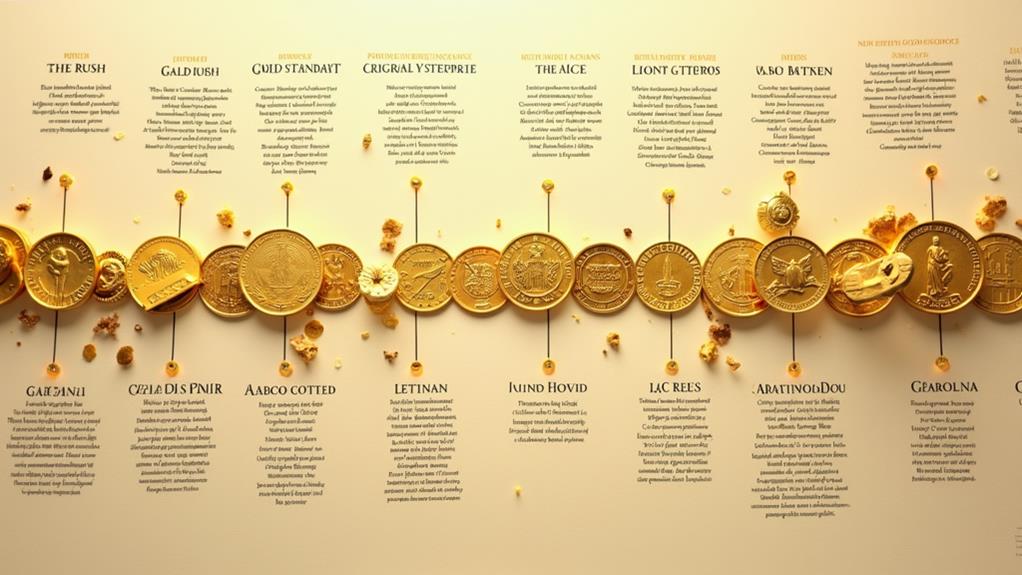
The evolution of global monetary systems, heavily influenced by the gold standard, set the foundation for the economic developments seen in the 20th century.
Gold price controls (1930s-1970s), such as those under the Bretton Woods Agreement, pegged the U.S. dollar to gold at $35 per ounce. The abandonment of the gold standard in 1971 led to increased market volatility.
Gold and geopolitical instability were evident during crises like the 2008 financial meltdown, where gold prices surged 20.58%.
During the Great Depression, there was significant reliance on gold-backed currency, while the collapse of the Gold Pool in 1968 marked the end of fixed rates.
The 1980s witnessed gold market liberalization, further shaping financial landscapes.
Gold Discoveries and Economic Impact
Significant gold findings have been powerful catalysts for economic transformation and development throughout history. For example, the 1848 California Gold Rush induced massive population influxes, fostering economic booms and infrastructure growth.
Likewise, the Witwatersrand Gold Rush transformed Johannesburg into a financial hub, influencing the global gold supply. The Klondike Gold Rush spurred advancements in transportation, reshaping the Yukon region.
- Economic Booms: Regional economies flourished due to gold mining activities.
- Infrastructure Development: New transportation routes and cities emerged.
- Global Influence: Countries with gold resources gained economic power.
- Price Fluctuations: Gold price controls (1930s-1970s) and findings impacted global markets.
These findings underscore gold's enduring role in shaping economies, particularly in developing regions.
The Rise and Fall of the Gold Standard

Gold findings spurred economic booms and laid the foundation for the gold standard—a monetary system that would dominate global finance for over a century.
The gold standard, first adopted by England in the early 19th century, linked currency value to gold. The Bretton Woods Agreement (1944) pegged the U.S. dollar to gold at $35 per ounce until 1973.
Despite serving as a hedge against inflation, gold price controls from the 1930s to the 1970s and economic strains from world wars disclosed the system's limitations.
The collapse of the Gold Pool in 1968 further destabilized the system, leading to global abandonment. Ultimately, the rigidity of the gold standard restricted monetary policy during crises, prompting its decline.
Gold During Economic Uncertainty
In the center of economic uncertainty, gold emerges as a cornerstone of stability, consistently attracting investors seeking refuge from market volatility. Gold's historical role as wealth preservation is underscored by its 20.58% appreciation during the 2007-2009 financial crisis.
High inflation periods further highlight its resilience, outperforming other asset classes when inflation surpasses 4.01%.
- Gold and currency devaluation: An inverse relationship with the U.S. dollar enhances gold's appeal during dollar depreciation.
- Gold trading: Heightened during geopolitical tensions, reflecting its safe-haven status.
- Gold investment products evolution: Offering diverse options for modern investors.
- Gold and global economic trends: Remains positively correlated with rising consumer prices, cementing its role as an inflation hedge.
These factors collectively underscore gold's enduring appeal in times of economic turmoil.
Factors Affecting Gold Prices

Amid various economic and geopolitical landscapes, several critical factors govern the fluctuations in gold prices.
The inverse relationship between the U.S. dollar's value and gold price controls (1930s-1970s) is significant. Geopolitical events often increase demand for gold, leading to price hikes, especially during instability.
Economic conditions like inflation bolster gold's role as a hedge. Mining output, gold, and central bank policies influence supply-demand dynamics, with purchases often raising prices.
Investor behavior during recessions underscores gold's status as a safe-haven asset. Advances in gold trading technologies and introducing gold-backed securities in the post-war economy have likewise impacted gold and asset allocation, further shaping price trends.
Gold as an Investment Asset
Given the multifaceted influences on gold prices, understanding its role as an investment asset becomes particularly significant. Gold remains a favored investment due to its historical performance as a hedge against inflation and economic instability. Furthermore, the historical performance of gold ETFs (exchange-traded funds) has also contributed to its status as a sound investment choice. Investors are drawn to the relatively low cost and ease of trading associated with gold ETFs, which allows for greater flexibility and liquidity in their investment portfolios. This combination of historical performance and accessibility has solidified gold's reputation as a valuable asset for investors seeking to diversify their holdings and mitigate risk.
With various investment options, such as gold bullion, gold ETFs, and gold IRA accounts, investors can diversify their portfolios effectively. Gold's ability to counterbalance during equity bear markets and its positive correlation with rising consumer prices further solidify its value.
- Gold price controls (1930s-1970s): Historical regulation impacts
- Gold market liberalization (1980s): Greater investment freedom
- Future trends in gold's financial role: Potential shifts in market dynamics
- Optimal allocation: Between 1% and 34%, ideally 17% for balanced risk-adjusted returns
Our Final Thoughts
In conclusion, gold's crucial role in financial history is evidenced by its enduring presence in monetary systems and its impact on economic events. Historical milestones such as the California Gold Rush and the gold standard have shaped economic policies and global trade. As an investment asset, gold remains a stable hedge against inflation and market volatility. Its value, influenced by various factors, underscores its importance in diversified portfolios, maintaining relevance across different economic climates.