The historical importance of gold investment spans millennia, touching on gold's profound influence on economic stability and wealth preservation. From ancient civilizations to modern financial markets, gold's role has evolved yet remained extremely important. This evolution—from its use in trade and religious artifacts to its function as a hedge against inflation and currency devaluation—provides valuable insights into why it remains a sought-after asset today.
The journey of gold through various economic paradigms, including the Gold Standard and Bretton Woods system, reveals much about its enduring appeal. How has this precious metal maintained its significance through centuries of economic upheaval?
Our Quick Summary
- Gold has been a reliable store of value across ancient civilizations, exemplified by its use in Egyptian, Roman, and Inca societies.
- The gold standard historically linked currencies to gold, providing monetary stability and influencing global economic policies.
- Gold thrives as a safe-haven asset during economic crises, protecting against inflation and currency devaluation.
- The introduction of gold ETFs in the early 2000s increased accessibility, making gold a viable investment for a broader audience.
- Gold's negative correlation with equities enhances portfolio diversification, especially during market downturns.
Gold in Ancient Civilizations

Throughout history, gold has been of immense significance in ancient civilizations, serving not only as a measure of wealth but also as a symbol of divine power and protection.
The Ancient Egyptians extensively used gold in jewelry and burial artifacts, epitomized by the iconic gold mask of Tutankhamun.
The Mesopotamians pioneered using gold as currency around 3000 BC, enhancing trade through gold bars and jewelry.
In ancient Rome, gold coins known as aureus were minted, influencing the empire's trade and economy.
The Inca civilization esteemed gold, leading to significant religious and social implications.
These practices illustrate gold's multifaceted role in ancient civilizations, encompassing currency, religious symbolism, and international trade, highlighting its enduring value.
Evolution of Gold as an Investment
Gold's transition from a symbol of ancient wealth to a modern investment asset underscores its enduring allure and utility. Historically, gold has been integral to global economies, evidenced by the gold standard and gold-backed currencies. The U.S. discontinued the gold standard in 1971, yet gold remains a critical inflation hedge and safe haven during economic recessions. With the advent of gold ETFs in the early 2000s, the accessibility of gold investment surged, reflecting evolving gold market trends over time. By examining the historical importance of gold investment, we can predict the future of gold investment based on historical trends.
| Period | Significant Event | Impact on Gold Investment |
|---|---|---|
| Ancient Civilizations | Gold as currency | Established gold's value and utility |
| 1944 | Bretton Woods Agreement | Fixed exchange rates with gold backing |
| 1971 | End of U.S. gold standard | Shifted to fiat currencies |
| Early 2000s | Introduction of gold ETFs | Increased accessibility and demand |
| Economic Recessions | Gold as an inflation hedge | Gold retains value, a safe haven asset |
Impact of the Gold Standard

The implementation of the gold standard in the mid-19th century represented a significant milestone in global economic policy. This system linked currency values directly to a fixed quantity of gold, constrained currency growth to gold reserves, and influenced monetary policy.
Gold investment strategies throughout history illustrate their role during economic crises, particularly during the Great Depression. Despite the Bretton Woods system's aim in 1944 to stabilize currencies by pegging them to gold, challenges led to its collapse in 1971.
Gold's role as a safe haven asset persisted, offering protection against inflation and currency devaluation. Thus, the gold standard profoundly impacted global finance, shaping how nations approached monetary stability and investment. Over time, the evolution of gold as a safe haven investment led to the development of new financial products, such as gold-backed exchange-traded funds (ETFs) and gold futures contracts. This expanded the accessibility of gold as a hedge against economic uncertainty, further solidifying its reputation as a reliable store of value. The continued demand for gold as a haven underscores its enduring appeal as a diversification tool in investment portfolios.
Bretton Woods System Collapse
As the gold standard profoundly influenced global financial systems, the subsequent era witnessed the establishment and eventual collapse of the Bretton Woods system. Established in 1944, this system pegged currencies to the U.S. dollar, convertible to gold at $35 per ounce.
The collapse in 1971, known as the Nixon Shock, ended dollar-to-gold convertibility due to rising inflation and U.S. trade deficits. By 1973, the transition to a fiat currency system marked a crucial shift in global finance.
This shift led to increased currency market volatility and a re-evaluation of gold reserves and gold-backed securities. The gold price history reflects these profound changes, underscoring the importance of gold in times of inflation and financial reforms.
Gold as a Safe-Haven Asset

During economic instability, investors often seek refuge in assets that can protect their purchasing power, with gold standing out as a prominent safe-haven asset. Gold has been widely regarded as a store of value for centuries, with a rich gold investment strategies through history dating back to ancient civilizations. Its scarcity, durability, and universal appeal have contributed to its status as a safe-haven asset. In times of uncertainty, investors often flock to gold as a hedge against inflation and currency devaluation, which is a testament to its enduring role in safeguarding wealth.
Historically, gold's value typically rises during inflation and market volatility, providing stability when stocks decline. Its independence from company performance or interest rates makes it a hedge against currency devaluation.
Significant financial crises, such as the 2008 recession and the COVID-19 pandemic, underscore gold's role in asset allocation and resilience.
- Gold market regulation ensures investor confidence by maintaining fair trading practices.
- Gold investment myths and facts often highlight its reliability during crises.
- Gold supply and demand history impact its market value and availability.
- Gold trading markets provide platforms for global investment.
Gold Investment Accessibility
Thanks to innovative financial instruments and digital platforms, navigating the dynamic world of gold investment has become increasingly straightforward. Investors are now able to access a wide range of options such as gold ETFs, futures contracts, and digital gold platforms, allowing them to diversify and optimize their portfolios. This ease of access and abundance of investment options has revolutionized the exploration of gold investment, making it more accessible and appealing to a wider range of individuals and organizations. As technology continues to advance, it is likely that even more innovative and inclusive investment opportunities in gold will become available in the future.
Gold investment accessibility has improved throughout the ages, with Exchange-Traded Funds (ETFs) like SPDR Gold Shares (GLD) enabling investors to gain exposure without physical ownership.
The evolution of gold trading technologies has simplified transactions via online platforms and apps, democratizing access. Products like gold coins and bars in various weights cater to individual investors with smaller budgets.
The rise of gold-backed cryptocurrencies offers a modern twist, linking digital assets to physical reserves.
Financial advisors emphasize gold's role in asset allocation, promoting it as a hedge against gold market crashes and inflation, underscoring its enduring value.
Gold Vs. Other Asset Classes
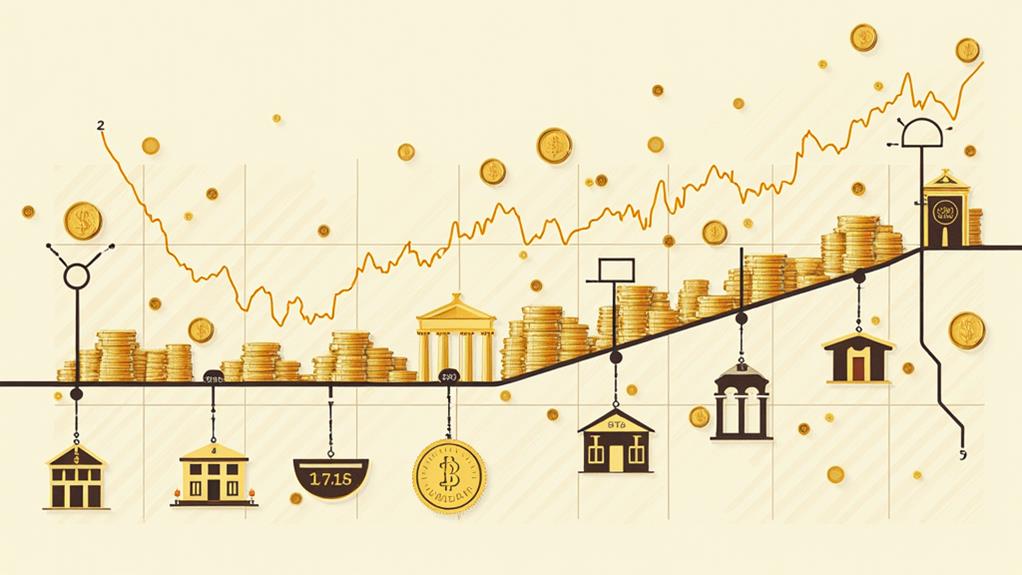
Building on the increased accessibility of gold investment, comparing gold with other asset classes is imperative to understand its unique benefits and limitations. Gold has been a long-standing safe haven asset, often considered a hedge against market volatility and inflation. It has withstood the test of time and has been a part of investment portfolios for centuries. Understanding the milestones in gold investing history, such as the gold standard and the establishment of gold-backed exchange-traded funds (ETFs), can shed light on the enduring value of gold as an investment. By comparing gold with other asset classes, investors can make informed decisions about diversifying their portfolios and potentially mitigating risks.
Gold's performance during economic downturns, often appreciating while stocks and bonds decline, underscores its role as a safe-haven asset. Unlike real estate or stocks, gold does not incur maintenance costs, providing ease of investment and liquidity.
Gold's negative correlation with equities, evidenced over the past decade, improves portfolio diversification. Its value increase during high inflation periods contrasts with the devaluation of cash assets, highlighting its inflation-hedging capabilities.
Despite an average return of 6-7%, gold's lower volatility and risk profile remain attractive for investors.
- Gold bars
- Gold certificates
- Gold's role in asset allocation
- Gold futures market
Our Final Thoughts
The historical examination of gold underscores its enduring significance in economic stability and wealth preservation. From ancient trade to its role in modern investment portfolios, gold has consistently served as a reliable plunge against inflation and currency devaluation. Its unique attributes, including low correlation with other asset classes, reinforce its status as a safe-haven asset. This timeless value, especially in periods of economic uncertainty, cements gold's place as an indispensable component of diversified investment strategies.