You'll find gold's investment history spans over 6,000 years, evolving from ancient ceremonial treasure to modern financial cornerstone. First minted as coins by the Lydians in 560 BC, gold established itself as a standardized currency before becoming the backbone of the global monetary system through the gold standard. Today, gold continues its legacy as a reliable hedge against economic uncertainty, offering multiple investment vehicles from physical bullion to ETFs. Understanding this rich history illuminates gold's enduring value.
Our Quick Summary
- Gold's monetary significance began with the Lydians' first gold coins in 560 BC, revolutionizing standardized trade and commerce.
- The gold standard emerged in the 17th century, providing economic stability until its abandonment in the 20th century.
- California's 1848 gold rush transformed global markets, with production increasing from $2 million to $100 million by 1855.
- Gold consistently performs as a safe-haven asset during economic crises, evidenced by price surges during the Great Depression.
- Modern gold investment options include physical purchases, ETFs, and mining stocks, with portfolios typically allocating 5-10% to gold.
Gold as Mankind's Oldest Precious Metal
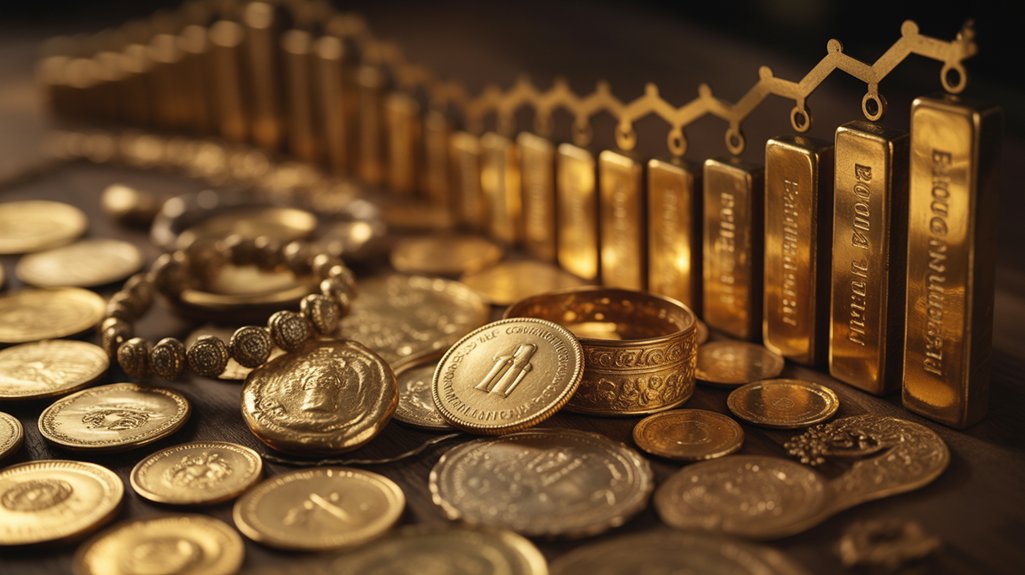
The allure of gold, humanity's oldest and most cherished precious metal, stretches back more than six millennia through the chronicles of civilization.
You'll find evidence of its prominence in ancient civilizations like Mesopotamia and Egypt, where it served as both currency and ceremonial treasure.
The establishment of gold as money began with the Lydians in 560 BC, who minted the first gold coins.
As societies evolved, the Greeks and Romans adopted gold standard practices, recognizing its unique properties of malleability and resistance to corrosion.
Today, while modern economies have moved beyond the gold standard, this precious metal remains a symbol of wealth and stability.
Ancient Egyptians lavishly adorned their tombs and temples with gold to symbolize divine status and eternal wealth.
The Origins of Gold as Currency in Ancient Civilizations

When ancient civilizations began searching for alternatives to bartering, gold emerged as the ideal solution for standardizing trade and commerce. The Lydians pioneered the creation of gold coins in the 6th century BCE, revolutionizing economic transactions throughout ancient societies.
Gold's inherent value, combined with its scarcity and durability, made it the perfect medium of exchange. As Greek and Roman civilizations adopted gold currency, it became deeply intertwined with power and divine authority.
This foundation eventually led to the establishment of the gold standard, which dominated global monetary systems from the 17th century until modern times.
Gold Standard: How Gold Became the Backbone of Economics

Modern economics found its cornerstone in the gold standard system, which emerged during the 17th century as nations sought to establish stability in international trade.
You'll find that the U.S. embraced this system in 1834, setting gold at $20.67 per ounce, while central bank gold reserves became essential for maintaining economic stability.
The gold standard's influence peaked before its eventual abandonment in the 20th century, particularly when the U.S. ended it in 1971.
The gold standard's dominance over global monetary policy reached its height just before nations began moving away from it permanently.”
This shift to a fiat currency relationship transformed how economies operated, yet gold's fundamental value persists today as a hedge against inflation and a strategic investment asset.
By the early 20th century, the gold standard had fostered unprecedented economic stability with over 60% of world economies adopting this system.
Historic Gold Rushes and Their Impact on Global Markets

Throughout history's most dramatic economic transformations, gold rushes have fundamentally reshaped global markets and societies, with revelations in California and Alaska standing as vital moments in economic development.
The impact on gold supply and demand was unprecedented, as California's gold production skyrocketed from $2 million to over $100 million between 1848 and 1855.
You'll find that these rushes didn't merely affect gold price history; they transformed entire economies.
When over 300,000 people flooded into California and 100,000 pursued Klondike's riches, they sparked massive infrastructure development, strengthened national currencies, and revolutionized international trade, though often at the expense of Indigenous communities.
These historical events foreshadowed modern trends where gold consistently emerges as a safe-haven asset during periods of economic uncertainty and geopolitical tension.
Gold During Major Economic Crises: Patterns Through History

Throughout history, you'll find that gold's relationship with economic crises discloses consistent patterns of investors pursuing refuge in this precious metal during turbulent times.
When examining events like the Great Depression's 60% surge in gold prices and the 1970s stagflation crisis's remarkable 2,300% increase, you can see clear evidence of gold's role as a safe-haven asset.
From the 2008 financial crisis to the COVID-19 pandemic, gold's significant price increases during periods of economic uncertainty continue to demonstrate its enduring value as a hedge against market instability.
This historical performance is why many investors now utilize Gold IRA accounts to protect their retirement savings against inflation while maintaining portfolio stability during economic downturns.
The Bretton Woods System and Nixon Shock Explained
When global leaders gathered in 1944 to establish the Bretton Woods system, they created a framework that would revolutionize international monetary policy for decades to come.
Under this system, the U.S. dollar became the world's anchor currency, fixed to gold at $35 per ounce.
Gold Confiscation: Historical Events and Their Lessons
Major economic crises have often prompted governments to take drastic measures concerning gold ownership, creating significant implications for private investors and citizens alike.
The U.S. Gold Reserve Act of 1934 exemplifies how gold confiscation can emerge during economic turmoil, as citizens were forced to exchange their gold for currency.
You'll find similar patterns throughout history, from Nazi Germany's seizure of Jewish citizens' gold to the 1970s stagflation period when soaring gold prices sparked fears of government intervention.
These historical events underscore why you need to understand gold investment regulations and remain alert about potential policy changes during economic crises.
Evolution of Gold Investment Vehicles Through Time
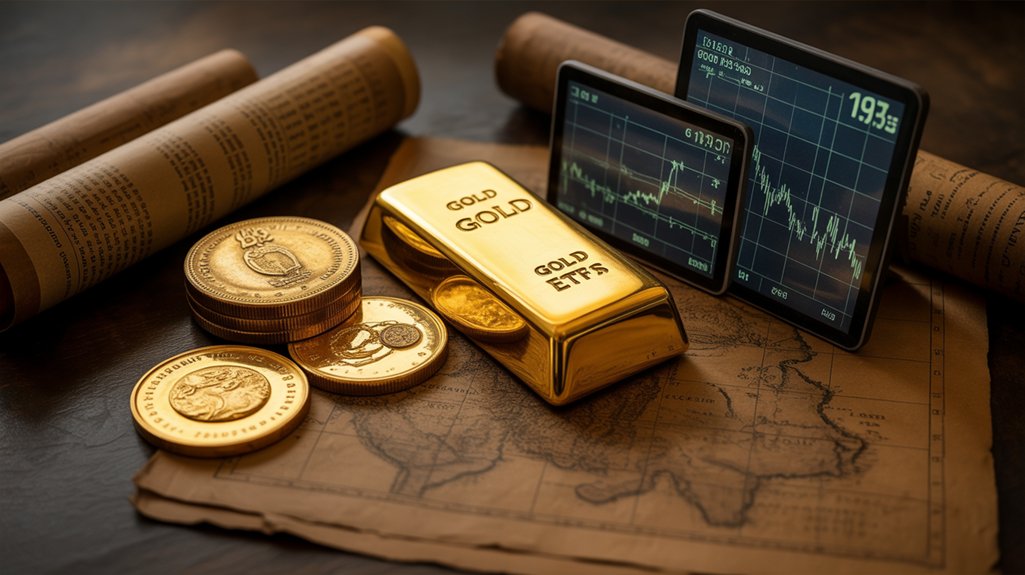
Throughout history, you'll find that central banks have maintained significant gold reserves as a cornerstone of monetary policy, with their holdings reflecting both economic power and financial stability.
The relationship between gold and fiat currency has evolved dramatically since the gold standard era, when paper money was directly convertible to physical gold at fixed rates.
As financial markets have modernized, you can now see how central banks continue to hold gold reserves strategically, even though currencies are no longer backed by gold, demonstrating the enduring value of this precious metal in the global financial system.
Central Banks and Gold Reserves: A Historical Perspective
Since the early days of modern banking, central banks have played a vital role in shaping the global monetary system through their management of gold reserves.
You'll find that central banks' relationship with gold peaked during the early 20th century when currencies were pegged to gold, ensuring international trade stability.
The Federal Reserve's establishment in 1913 marked a significant shift, though the U.S. didn't abandon the gold standard until 1971.
Today, you're witnessing a resurgence in gold as a safe haven asset, with countries like China, Russia, and Turkey increasing their holdings amid economic uncertainties, while modern investment vehicles like gold-backed ETFs offer new ways to participate in gold investment history.
Gold vs. Fiat Currency: A Centuries-Old Relationship
When gold first emerged as a medium of exchange in ancient civilizations, its inherent value and scarcity set it apart from other forms of currency.
Throughout history, gold's role as a store of value has remained constant, even as monetary policy effects shifted from gold-backed currencies to fiat systems in the 20th century.
You'll find that gold's performance during financial crises, including its inflation-adjusted peak of $3,500 in 2025, demonstrates its enduring strength as a hedge against economic uncertainty.
This relationship between gold and fiat currency continues to evolve, with gold maintaining its position as a reliable safe haven during periods of market volatility.
Modern Gold Investment Strategies: Learning from History

As investors navigate through today's complex financial landscape, learning from gold's historical performance has become crucial for developing effective modern investment strategies.
By studying gold market cycles, you'll understand why a portfolio diversification of 5-10% in gold has proven effective, demonstrated by its 60% surge during the Great Depression and 34% rise during the 2020 pandemic.
Long-term gold returns have shown a consistent 10-11% annual growth over five decades, making it a reliable hedge against economic uncertainty.
You can access gold through physical purchases, ETFs, or mining stocks, adapting your approach based on market conditions.