The voyage of gold investing has been shaped by journey through gold investing history that have greatly influenced its status and appeal as an investment vehicle. From ancient civilizations recognizing gold's inherent value to the 19th-century establishment of the gold standard, each event has played a very important role in molding gold's financial narrative.
The downfall of the Bretton Woods system and the subsequent liberalization of gold ownership further altered its market dynamics. As we examine these historical developments and their impact on contemporary investment strategies, one might consider how these events continue to shape the perception and utility of gold in today's unpredictable economic landscape.
Our Quick Summary
- The Lydians minted the first standardized gold coins around 550 BCE.
- The U.S. abandoned the gold standard in 1971, transitioning to fiat currencies.
- The 2008 financial crisis led to a gold price peak of $1,901.34 per ounce.
- The introduction of gold ETFs in 2003 revolutionized market accessibility.
- China's 2004 lifting of the gold ban significantly increased global demand.
Ancient Civilizations and Gold

Milestones That Shaped the Expedition of Gold Investing
Ancient Civilizations and Gold
Gold has been a coveted asset since ancient times, reflecting wealth, power, and spiritual significance across various civilizations. The Lydians minted the first gold coins around 550 BCE, marking the inception of gold as a standardized medium of exchange.
Ancient civilizations and gold were intertwined. The Egyptians used gold for jewelry and burial artifacts, symbolizing status. In Rome, the gold aureus became a crucial currency.
The Incas esteemed gold as “the tears of the sun,” using it in religious rites. Gold's desirability in ancient cultures established its role in wealth preservation and trade, influencing economic interactions for centuries.
These early uses underscore gold's enduring value across history.
The Gold Standard Era
The gold standard era, an essential chapter in financial history, saw currencies tied directly to gold, fundamentally shaping global economic frameworks. By 1900, most nations had adopted this system, with the gold backing of the U.S. dollar firmly established.
The Great Depression highlighted the importance of gold investment during economic crises, although it likewise pressured the system. The end of the gold standard in the U.S. (1933) marked a significant shift as gold hoarding increased.
The Bretton Woods Agreement (1944) aimed to stabilize global currencies, pegging the U.S. dollar to gold at $35 per ounce. This period underscored gold's vital role in international finance until 1971 when President Nixon suspended gold convertibility.
Bretton Woods System Collapse
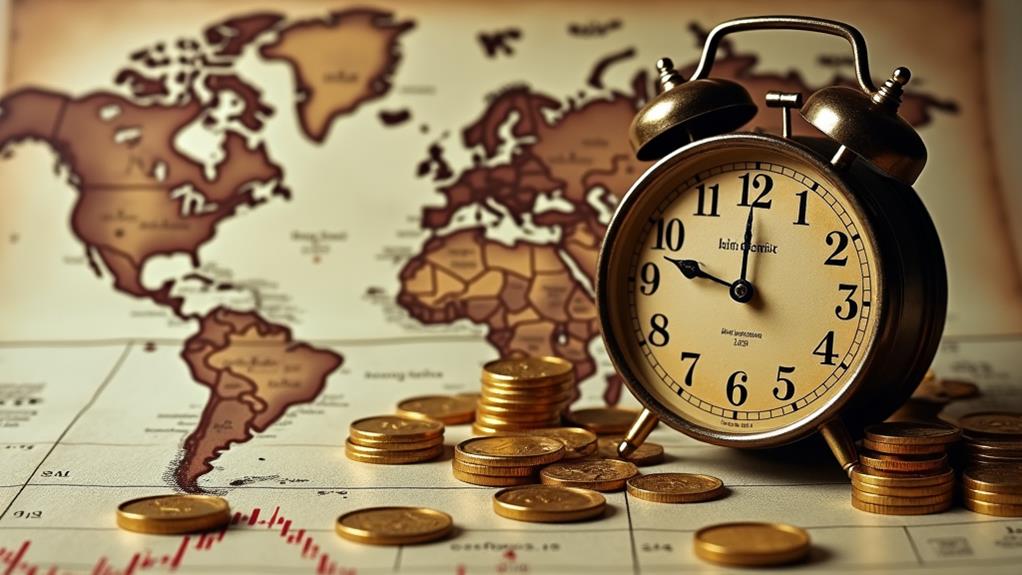
As the world moved beyond the era defined by the gold standard, the Bretton Woods system emerged as the new framework for international monetary policy. Established by the Bretton Woods Agreement (1944), it pegged the US dollar to gold at $35 per ounce and other currencies to the dollar.
Nevertheless, the system began to disintegrate in 1971, when President Nixon removed gold from the Bretton Woods system, leading to the end of the gold standard in the U.S. By 1973, floating exchange rates replaced fixed values.
The increased monetary policy flexibility spurred inflation and currency volatility. During the 1980s, gold price stabilization policies emerged, reinforcing gold's role as an inflation hedge during economic uncertainty.
Gold as a Free-Market Commodity
Gold's evolution into a free-market commodity marked a significant shift in its economic role, transitioning from a currency standard to a market-driven asset.
The end of the gold standard in the U.S. (1933) initiated this transformation, eventually culminating in the global gold market liberalization of the 1980s.
Gold's price stabilization policies in the 1980s further reinforced its position as a free-market asset that responds to supply and demand dynamics.
Gold's role as a safe haven asset during the war and its utility in international trade settlements underscore its enduring value.
Significant milestones include:
- End of the gold standard in the U.S. (1933)
- Global gold market liberalization (1980s)
- Gold price stabilization policies (1980s)
- Gold as a safe haven asset during war times
Liberalization of Gold Ownership

Liberalization of gold ownership has played a vital role in democratizing access to this historically significant asset.
The gold investment boom of the 1970s set the stage for the global gold market liberalization in the 1980s. In 1991, India liberalized gold ownership, leading to increased demand.
In the 1990s, countries like South Africa and Russia relaxed gold laws, enhancing public investment. China's 2004 lifting of its gold ban further fueled global demand.
The introduction of gold exchange-traded funds (ETFs) in 2003 made gold more accessible to retail investors, revolutionizing the market. Historical gold ETF performance has demonstrated the ability of these funds to closely track the price of gold, providing investors with a convenient way to gain exposure to the precious metal without the need for physical ownership. As a result, gold ETFs have become a popular investment option for those seeking to diversify their portfolios and hedge against inflation. Additionally, the introduction of gold ETFs has also contributed to increased liquidity and transparency in the gold market, further enhancing the accessibility and appeal of investing in gold.
Gold as Safe-Haven Asset
The widespread liberalization of gold ownership paved the way for its resurgence as a safe-haven asset during economic instability and geopolitical tension. Gold has historically been seen as a reliable store of value, dating back to ancient civilizations. Its scarcity and physical properties make it a timeless and enduring asset. Exploring gold's investment history guide is rich with examples of investors turning to gold during times of crisis, and its return to prominence in modern times is a testament to its enduring appeal as a safe-haven investment.
Gold's role in the 2008 financial crisis exemplifies this, with a surge in the price that peaked at $1,901.34 per ounce as investors sought refuge from volatile markets.
The establishment of major gold reserves in the 20th century further solidified its position as a foundation of stability.
- Gold price surge (2008 financial crisis): Investors flocked to gold, causing prices to soar.
- Gold as a diversification asset: Its low correlation with stocks and bonds makes it invaluable.
- Gold investment during hyperinflationary periods: It serves as a hedge against currency devaluation.
- Establishment of major gold reserves (20th century): Bolstered confidence in gold's stability.
Gold Price Trends

Over the past three decades, gold prices have exhibited a remarkable upward trajectory, highlighting its enduring appeal as an investment vehicle. Beginning in the 1980s, gold price stabilization policies helped maintain relative consistency. Nevertheless, the gold removal from the Bretton Woods system in 1971 marked the onset of substantial price fluctuations. The establishment of major gold reserves throughout the 20th century further influenced market dynamics.
| Year | Price ($) | Event | Impact |
|---|---|---|---|
| 1994 | 385 | Stable | |
| 1999 | 252.95 | Low | |
| 2011 | 1,901.34 | 2008 financial crisis | Surge |
| 2024 | 2,460 | COVID-19 pandemic | Surge |
Notably, the development of the gold futures market provided additional avenues for investors, while geopolitical tensions and crises, like the 2008 financial crisis, triggered significant price surges.
Economic Events and Gold
Amid various economic events, gold has consistently demonstrated its strength as a hedge against uncertainty. Historical returns of gold bar and coin investments have shown that gold tends to perform well during periods of market volatility and economic downturns. This has made it a popular choice for investors looking to diversify their portfolios and protect their wealth. Whether it's geopolitical tensions, inflation concerns, or fluctuations in currency values, gold has proven its resilience time and time again.
The removal of gold from the Bretton Woods system in 1971, followed by lifting gold price controls in 1974, allowed market forces to determine gold prices, significantly impacting its role in wealth preservation.
The correlation between inflation and gold prices became evident during the 1970s oil crisis, peaking at $850 per ounce in January 1980.
The 2008 financial crisis saw the gold price surge, surpassing $1,000 per ounce, as investors sought safe-haven assets.
Key Economic Events Impacting Gold:
- Gold removal from Bretton Woods system (1971)
- Gold price controls lifted (1974)
- Gold price surge (2008 financial crisis)
- Correlation between inflation and gold prices
Future of Gold Investment

Forecasts for 2024 suggest that gold prices will continue upward, potentially reaching long-term evaluations of $14,755 per ounce. This projection is bolstered by historical trends, such as the gold price surge during the 2008 financial crisis and the impact of gold's removal from the Bretton Woods system in 1971. Economic instability and inflation further reinforce gold's appeal as a hedge against market volatility.
| Crucial Event | Impact on Gold Investment |
|---|---|
| Gold price surge (2008 financial crisis) | Increased demand as a safe haven asset |
| Gold removal from Bretton Woods system (1971) | Elevated gold's role in global finance |
| Gold IRA launch | Expanded gold investment options |
| Establishment of major gold reserves (20th century) | Strengthened national economic security |
| Global gold market liberalization (1980s) | Increased accessibility for investors |
Wealthy investors, including Mark Zuckerberg and Sam Altman, are turning to gold for wealth preservation, highlighting its potential for significant growth in investment portfolios.
Our Final Thoughts
The voyage of gold investing, marked by critical milestones from ancient civilizations to modern financial systems, underscores its enduring significance. The gold standard, the Bretton Woods system, and the liberalization of gold ownership have contributed to its stability and appeal. Gold's role during economic upheavals has been crucial as a safe-haven asset. Understanding these historical contexts and trends is fundamental for comprehending gold's future potential as a strategic investment.