As we approach 2024, the landscape for gold investment appears particularly favorable, driven by an array of compelling factors. Potential interest rate cuts by the Federal Reserve, ongoing inflation concerns, and a depreciating dollar are setting the stage for gold to attract attention as a secure asset. Furthermore, heightened central bank acquisitions, especially from economic powerhouses like China and India, underscore the rising demand amid geopolitical tensions.
With gold prices nearing unprecedented highs, investors are eagerly observing if 2024 might be the golden year for this precious metal. What could these dynamics imply for your portfolio?
As we approach 2024, the landscape for gold investment appears particularly promising, driven by a combination of compelling factors. Potential interest rate cuts by the Federal Reserve, persistent inflation concerns, and a weakening dollar are creating an environment where gold is increasingly viewed as a safe-haven asset. In addition, increased central bank acquisitions, especially from economic giants like China and India, highlight the growing demand amidst geopolitical uncertainties.
With gold prices approaching record highs, investors are keenly watching to see if 2024 might be the optimal year for gold investment 2024. What could these dynamics mean for your portfolio in this potentially golden year for the precious metal?
Our Quick Summary
- Gold reached a record high of $2,409 per ounce, reflecting strong investment demand and market confidence.
- Anticipated Federal Reserve rate cuts in 2024 will boost gold's investment appeal.
- Central banks in China, India, and Turkey are significantly increasing gold purchases amid geopolitical and inflationary pressures.
- Gold consistently outperforms traditional asset classes, especially during economic uncertainty and inflation surges.
- Technological advancements in gold investment, such as digital gold assets and enhanced trading platforms, increase accessibility and efficiency.
Current Economic Conditions

Amid shifting economic dynamics, gold prices skyrocketed to an unprecedented $2,409 per ounce in 2024, underscoring strong investment demand despite the Federal Reserve's rate hikes.
Current economic conditions disclose significant trends:
Gold Price Trends:
– Historical performance demonstrates gold's capability to outpace traditional asset classes.
Economic Forecasts:
– Anticipation of potential interest rate cuts by the Federal Reserve could boost gold's appeal.
Inflation Rates:
– The weakening purchasing power of the dollar and persistent inflationary pressures have heightened gold's attractiveness.
Central Bank Policies:
– Geopolitical unrest has driven substantial gold purchases by central banks in nations such as China, India, and Turkey.
These factors collectively underscore the vigorous demand for gold amid volatile economic landscapes.
Gold as a Safe-Haven Asset
As gold prices ascended to a remarkable $2,409 per ounce in 2024, the metal's role as a safe-haven asset has been further cemented. Economic uncertainty and geopolitical events have significantly influenced gold price drivers, leading investors to seek stability and investment diversification. Central banks in emerging markets like China, India, and Turkey have increased their gold reserves, recognizing gold's reliability during turbulent times. Historically, gold has outperformed traditional asset classes, offering a secure store of value during financial crises.
| Year | Gold Price (USD) | Major Event |
|---|---|---|
| 2024 | $2,409 | Geopolitical tensions |
| 2020 | $2,067 | COVID-19 pandemic |
| 2008 | $869 | Global financial crisis |
Thus, gold continues to be a preferred plunge against instability.
Interest Rate Cuts

How do anticipated interest rate cuts by the Federal Reserve in 2024 impact gold investment?
Anticipated interest rate cuts by the Federal Reserve in 2024 are expected to improve gold's appeal as a safe-haven investment, driving demand and potentially increasing prices.
Historically, interest rates and gold prices exhibit a strong inverse relationship. Lower rates reduce the opportunity cost of holding non-yielding assets like gold, thus increasing its attractiveness.
In response to these projected rate cuts, emerging market central banks, particularly in China and India, have increased their gold purchases, amplifying global demand.
Given current gold price projections of around $2,180 per troy ounce and the prevailing global economic conditions, 2024 appears poised to be an optimal year for gold investment, particularly if market sentiment favors stability.
Geopolitical Factors
Geopolitical unrest often drives investors towards gold as a safe haven asset, making it particularly appealing in 2024 amid rising global tensions.
Central banks in emerging markets, including China and India, have significantly increased their gold purchases in response to geopolitical uncertainties, further bolstering demand.
As these geopolitical factors weaken the dollar's purchasing power, gold's role as an inflation hedge becomes increasingly relevant to investors.
Global Political Unrest
Given global politics' complex and unpredictable nature, investors frequently turn to gold as a safe-haven asset during unrest.
Historical gold performance shows that periods of geopolitical risk often lead to increased gold demand trends. For example, tensions in 2024 may drive market volatility, leading to heightened interest in gold investments.
Central banks in emerging markets like China and India have already made substantial gold purchases, indicating strategic moves to hedge against global uncertainties.
Furthermore, anticipating Federal Reserve rate cuts could further improve gold's appeal.
Safe Haven Demand
The allure of gold as a safe-haven asset becomes particularly pronounced during global political turbulence. In 2024, geopolitical unrest has heightened, increasing the demand for gold. This trend is evident as central banks in emerging markets like China, India, and Turkey have ramped up their gold purchases, responding to geopolitical uncertainties. Historical data suggests that gold prices rise amid significant geopolitical risks as investors seek stability and protection against market volatility. Consequently, gold market analysis and investment research indicate a strong outlook for gold. Furthermore, safe storage solutions are becoming critical as investors prioritize security. The anticipation of further geopolitical conflicts in 2024 underscores the continued demand for gold as a reliable investment.
| Geopolitical Factor | Effect on Gold | Investor Response |
|---|---|---|
| Conflict | Price Increase | Higher Demand |
| Economic Instability | Price Increase | Higher Demand |
| Central Bank Purchases | Price Increase | Strategic Buying |
| Historical Trends | Price Increase | Safe Haven Demand |
| Anticipated Conflicts | Price Increase | Continued Interest |
Gold Vs. Other Investments

In 2024, gold demonstrated its resilience and appeal by reaching a record high of $2,409 per ounce, significantly outperforming traditional asset classes such as U.S. stocks and bonds.
The surge underscores strong gold supply and demand dynamics and timely investment decisions. Investors increasingly recognize the importance of portfolio allocation, often dedicating 5 to 10% to gold to hedge against inflation and diversify risk.
Contrary to common gold investment myths, historical data uncovers gold's consistent outperformance relative to U.S. equities over two decades.
As geopolitical tensions and expectations of Federal Reserve rate cuts persist, gold's role as a safe haven asset solidifies, making 2024 a crucial year for reevaluating investment strategies.
Central Bank Purchases
In 2024, central banks in emerging markets such as China, India, and Turkey have markedly increased their gold purchases, contributing significantly to the surge in gold prices.
This strategic reserve accumulation is driven by a need to hedge against inflation and geopolitical risks, further solidifying gold's status as a safe haven asset.
With central banks globally purchasing over 1,000 tons of gold in 2023, the highest annual demand in over 50 years, this trend is expected to strengthen gold's appeal as a long-term investment.
Key Market Drivers
Central bank purchases have emerged as a crucial market driver in 2024, with institutions in emerging markets such as China, India, and Turkey playing a fundamental role.
These banks have significantly increased their gold acquisitions, contributing to the heightened demand and record gold prices of $2,409 per ounce. This trend reflects a strategic shift towards gold to strengthen financial stability amid volatile economic indicators and uncertain financial market conditions.
- Gold market liquidity is improved by consistent central bank buying.
- Emerging markets' central banks diversify reserves to hedge against economic uncertainties.
- The geopolitical landscape and inflationary pressures further motivate these acquisitions.
These actions by central banks underscore the crucial role of gold in maintaining economic resilience.
Strategic Reserve Accumulation
The surge in central bank gold purchases, particularly by institutions in China, India, and Turkey, underscores a strategic action to strengthen financial stability amid prevailing economic uncertainties.
In 2024, these central banks significantly increased their gold reserves, increasing demand and driving prices to record highs.
This trend reflects a broader strategy among central banks to diversify assets and hedge against economic uncertainties, reinforcing gold's role in the precious metals market.
The substantial purchases are likewise a response to geopolitical tensions and anticipated inflationary pressures, enhancing gold's status as a safe haven.
Historical data supports this, correlating central bank buying and bullish gold trends. This indicates underlying solid market demand and confidence in gold's long-term stability.
Technological Advancements

With technological advancements, the landscape of gold investment is undergoing significant transformation.
These innovations are reshaping various market aspects, making 2024 an interesting year for potential investors.
Crucial developments include:
- Gold refining processes have improved, ensuring higher purity standards and improving the quality of gold investments.
- Digital gold assets have emerged through blockchain technology, allowing investors to diversify their portfolios with gold-backed cryptocurrencies.
- Gold trading platforms have become more sophisticated, enabling real-time buying, selling, and tracking of gold investments.
Moreover, improved data analytics tools now provide investors with deeper insights into market trends and price movements, assisting in more informed decision-making.
Such advancements collectively contribute to a more accessible and efficient gold investment environment.
Inflation and Currency Fluctuations
As inflation surges and the dollar weakens, gold's value has skyrocketed to a record high of $2,409 per ounce in 2024, underscoring its role as a strategic hedge against currency fluctuations. Inflation concerns and currency fluctuations have driven investors toward gold, seeking stability and effective risk management strategies. Historical performance data discloses that gold has consistently outperformed traditional assets, such as U.S. stocks and bonds, over the past two decades.
| Inflation Factor | Impact on Gold |
|---|---|
| Surge in Inflation Rates | Increased Gold Demand |
| Federal Reserve Rate Changes | Higher Gold Prices |
| Currency Devaluation | Gold as a Hedge |
| Geopolitical Tensions | Amplified Gold Value |
| Central Bank Purchases | Fortified Gold Market |
Given the current economic landscape, incorporating gold into an investment horizon offers a strong method for managing inflation and currency fluctuations risks.
Strategies for Diversification
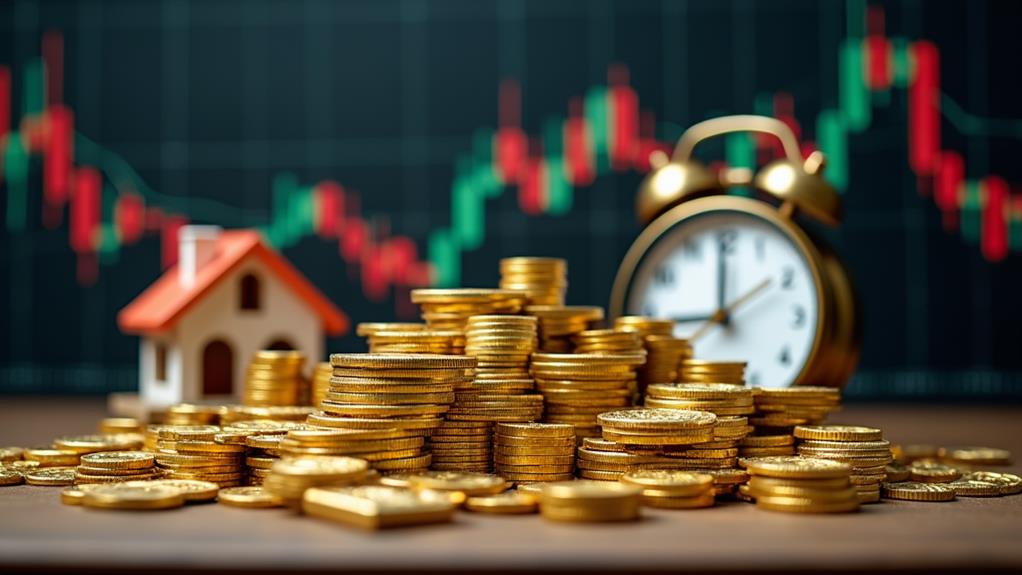
Inflation and currency fluctuations have underscored the importance of gold as a reliable hedge, drawing investors to seek more resilient strategies for portfolio diversification.
Expert analysis suggests incorporating gold ETFs to balance asset allocation, thus mitigating investment risks. Diversifying with gold has been shown to stabilize portfolios, particularly as gold prices peak.
- Gold IRAs: Including physical gold in retirement plans offers tax advantages and market fluctuation protection.
- Gold ETFs: These provide a liquid and convenient means to invest in gold, augmenting portfolio flexibility.
- Mixed Asset Classes: Combining gold with stocks and bonds can improve performance, especially during geopolitical unrest.
Allocating 5-10% of a portfolio to gold can significantly boost diversification, safeguarding against economic uncertainties.
Our Final Thoughts
The confluence of anticipated interest rate cuts, persistent inflation, and a weakening dollar in 2024 creates a favorable environment for gold investment. Central bank purchases, especially from China and India, further underscore gold's growing appeal amid geopolitical uncertainties. With gold prices potentially reaching all-time highs, the year presents an optimal opportunity for investors seeking a stable, safe-haven asset. Exploration strategies should consider the unique advantages gold offers in the current economic landscape.