The allure of gold as a formidable investment can be traced back to ancient civilizations, where its unique properties and inherent value quickly made it a cornerstone of economic systems. The origins of gold as investment can be seen in the first gold coins, minted in Lydia around 600 BCE, which revolutionized trade and set a precedent for gold's role in wealth preservation and stability.
This precious metal's journey from ancient markets to modern investment portfolios reflects its enduring value and strategic significance. How has gold maintained its status through millennia of economic fluctuations and geopolitical shifts? This question invites an enchanting exploration of gold's persistent importance in finance. Gold has long been treasured for its rarity, durability, and universal appeal, making it a timeless store of value in uncertain times. Its intrinsic qualities have made it a trusted asset for diversifying portfolios and hedging against inflation. The evolution of gold as a safe haven investment has only solidified its position as a cornerstone of financial stability and security.
Our Quick Summary
- Gold was first standardized as currency in Lydia around 600 BCE, marking its initial role in investment.
- Ancient civilizations like Egypt and Rome used gold to symbolize wealth and divine authority, establishing its lasting cultural significance.
- The gold standard, adopted by the UK in 1821 and the U.S. in 1900, linked currency value to gold, stabilizing economies.
- Gold has consistently outperformed CPI inflation since 1971, demonstrating its reliability as an investment.
- Geopolitical tensions and economic uncertainties continue to drive strong demand for gold, reinforcing its status as a safe haven asset.
Ancient Civilizations and Gold

The allure of gold has captivated human civilizations since ancient times. Around 3000 BCE, the Mesopotamians and Egyptians used gold.
Ancient civilizations esteemed gold for its beauty and rarity, often viewing it as a symbol of divine authority.
Gold in ancient Egypt was particularly significant, where it was crafted into exquisite gold jewelry as wealth and often buried with pharaohs to signify status.
The establishment of gold as currency began with the minting of the first gold coins in Lydia around 600 BCE.
These practices were supported by gold mining, which fueled gold's economic and cultural prominence.
This precious metal's historical role underpinned the prosperity and power of various ancient empires.
Gold and Global Trade
Gold has played a crucial role in global trade, beginning with its use as a standardized currency around 600 BCE, facilitating commercial exchanges among ancient civilizations.
Pursuing gold influenced significant historical events, such as the Spanish conquest of the Americas, driven by the desire for gold wealth.
Today, gold continues to impact global trade, with major producers like China, Australia, and Russia shaping economic dynamics and currency values on international markets.
Ancient Trade Routes
Ancient trade routes, such as the renowned Silk Road, were vital conduits for exchanging gold, interlinking vast regions from Europe to Asia, and fostering global commerce.
Gold trade routes connected ancient civilizations with distant markets, including Ancient Egypt and Ancient Greece. The Silk Road facilitated the flow of gold as a store of value, enhancing its role in economic transactions.
With their seafaring prowess, the Phoenicians transported gold across the Mediterranean, bolstering trade networks. Gold artifacts found in burial sites underscore their cultural and religious significance, influencing trade practices.
The Roman Empire expanded its trade routes to secure gold, underscoring its importance in ancient economic systems.
Currency and Exchange
In the realm of currency and exchange, the introduction of gold coins around 600 BCE in Lydia marked a significant evolution in global trade systems. These coins simplified transactions and established a standard for monetary systems worldwide.
Over centuries, gold's role in international trade grew, with kingdoms measuring wealth by gold reserves. The gold standard theory later anchored national currencies to gold, ensuring economic stability. Gold's role in financial history has been monumental, with the precious metal being used as a medium of exchange and a store of value for centuries. Even after the gold standard was abandoned in the 20th century, gold continues to be a vital asset in global finance, with many countries holding significant gold reserves as a hedge against economic uncertainty. The influence of gold on the world economy is undeniable, and its status as a safe-haven investment has solidified gold's place in financial history.
By the 1900s, the U.S. Gold Standard Act linked the dollar to a specific amount, underscoring the relationship between gold and national currencies.
Eventually, gold-backed paper currency emerged, maintaining gold's essential role in commerce across different cultures until fiat currencies became predominant.
Gold's enduring legacy in trade illustrates its historical and economic significance.
Economic Impact Analysis
Evaluating gold's economic impact on global trade uncovers a multifaceted relationship that has evolved over millennia. Gold's role in international trade began as early as 600 BCE, simplifying exchanges and establishing monetary systems.
The Spanish conquest of the Americas in the 16th century underscored gold's influence on economic power. The U.S. Gold Standard Act of 1900, which fixed the dollar to gold, facilitated stable trade until its suspension in 1933.
Gold's value, often viewed as a hedge against inflation, has consistently outperformed CPI inflation with an annualized return of 7.9% since 1971. Demand from countries like India and China continues to influence global trade, underscoring gold's enduring significance in wealth preservation and economic stability.
Evolution of the Gold Standard
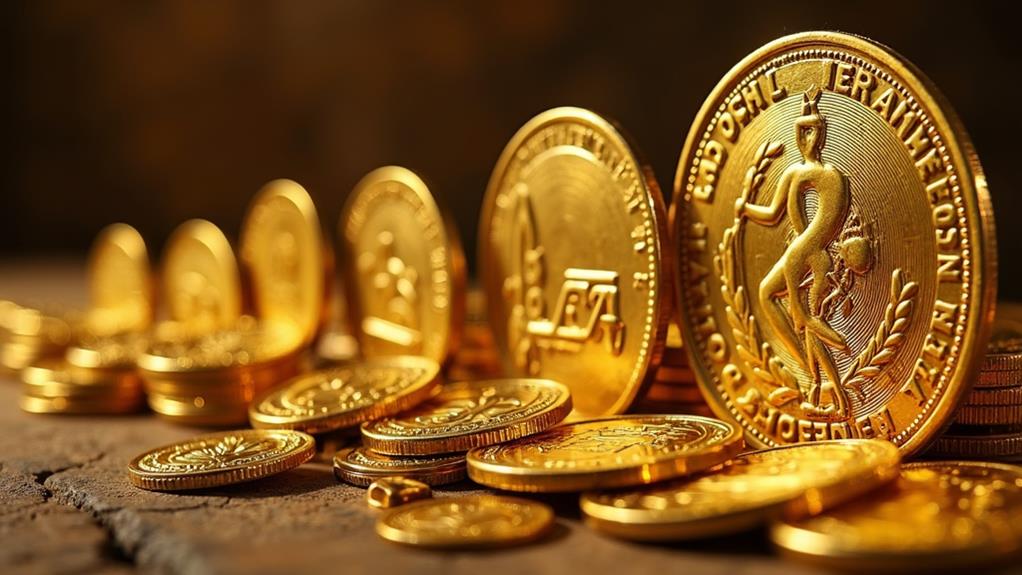
The gold standard has played a significant role in shaping modern monetary systems, beginning with its formal adoption by the United Kingdom in 1821. Early banking systems relied on gold standards, where gold reserves in early banks solidified trust in financial transactions. Gold's role as a financial asset in ancient times laid the foundation for its later use in introducing gold coins as investment vehicles. The stability provided by gold reserves notably influenced the formation of banks.
| Year | Event | Impact |
|---|---|---|
| 1821 | UK adopts gold standard | Establishes monetary stability |
| 1900 | US Gold Standard Act | Fixes dollar value to gold |
| 1933 | Roosevelt suspends the gold standard | Aims to stabilize the economy |
| 1944 | Bretton Woods Agreement | Creates modified gold standard |
| 1971 | Nixon Shock | Ends Bretton Woods system |
These milestones highlight gold's essential role in financial history.
Enduring Value of Gold
Gold's allure transcends time and geography, manifesting its enduring value through centuries of human history. Its use dates back to 3000 BCE, symbolizing wealth and power.
The first gold coins, minted around 600 BCE, established gold as a standard for monetary systems, simplifying trade and bolstering economies.
During the 19th century, gold and speculation saw significant activity, further entrenching its economic importance.
Gold's role as a reliable medium has been crucial in international trade.
The early modern period witnessed refined gold investment practices, leveraging its finite supply and unique properties. Throughout the early modern period, gold became not only a symbol of wealth and power but also a reliable store of value. Its scarcity and resistance to corrosion made it an attractive investment option for individuals and institutions alike. The gold investment journey through the ages stretches back thousands of years, with civilizations from ancient Egypt to the Roman Empire recognizing its intrinsic value. This long-standing tradition contributed to the development of sophisticated gold investment practices that continue to shape the modern financial landscape.
Notably, gold has consistently outperformed during economic instability, reinforcing its status as a safe-haven asset and reliable store of value, preserving purchasing power over time.
Cultural Aspects of Gold Investment

Gold has held a profound place in human culture, from its use in ancient Mesopotamian and Egyptian societies as a symbol of wealth and divine power to its modern-day significance in religious ceremonies and status symbols.
This precious metal's cultural importance transcends its economic value, evident in practices such as minting the first gold coins in Lydia around 600 BCE, which revolutionized trade and monetary systems.
Furthermore, gold's role in traditional rituals, such as gifting gold jewelry during weddings and festivals, underscores its enduring cultural significance across diverse societies.
Gold in Ancient Civilizations
In ancient civilizations, gold's multifaceted role extended far beyond mere currency, embodying profound cultural and religious significance.
Gold in ancient civilizations like Mesopotamia and Egypt marked the origins of gold as an investment. The early use of gold in economic systems began with the Lydians minting the first gold coins around 600 BCE, establishing its monetary value.
In Mesopotamia, gold was used for decorative purposes and as a symbol of social status. By the Roman Empire, gold became integral to the economy, with emperors issuing gold coins to solidify their role in commerce and represent the empire's power.
These practices laid the groundwork for gold's enduring appeal in modern investment.
Symbolism in Modern Times
Throughout modern times, the symbolic significance of gold has remained deeply embedded in various cultural contexts, transcending its economic value. Gold continues to symbolize wealth and status, prominently featured in jewelry and luxury items, reflecting personal achievement and cultural heritage.
Historically, gold bullion's role as a medium of exchange has enhanced its appeal as a safe haven investment. The association of gold and royalty further underscores its prestige across generations. Throughout history, gold has been seen as a symbol of wealth and stability, making it a highly sought-after asset in times of economic uncertainty. Its value has been recognized across various cultures and societies, solidifying its position as a reliable investment vehicle. The rich and intricate history of gold investment is a testament to its enduring allure and value.
Gold's role in international trade, rooted in the Middle Ages' gold investment practices and its importance during the Industrial Revolution, has shaped modern perceptions of its value.
Gold remains a potent symbol of love, commitment, and prosperity in weddings or significant life events.
Religious and Ritual Significance
Across various cultures, gold's religious and ritual significance has profoundly influenced its status as an investment. Gold is honored for its purity and brilliance and symbolizes divine power and status, as evidenced in ancient Egyptian artifacts and religious icons. In Hinduism, gold is sacred and integral to rituals, signifying prosperity. Christianity uses gold in religious artifacts, reflecting its divine symbolism. The Greeks and Romans crafted gold jewelry and ceremonial items for deities. Gold's cultural significance endures today in religious ceremonies, underscoring its spiritual and economic value.
| Region | Context |
|---|---|
| Medieval Europe | Gold in religious icons |
| Byzantine Empire | Gold in religious artifacts |
| Colonial Trade | Gold's role in rituals |
The use of gold in various religious contexts has continuously reinforced its esteemed status.
Future Outlook for Gold
Amid ongoing geopolitical tensions and economic uncertainty, the demand for gold is anticipated to remain strong, reinforcing its status as a safe-haven asset.
Several important factors shape the future outlook for gold:
- Supply Sustainability: Innovations in mining technology and increased recycling of gold from electronic waste are expected to improve supply sustainability and reduce environmental impacts.
- Inflation Hedge: Gold will likely continue to serve as a hedge against inflation, especially as central banks maintain low interest rates.
- Historical Returns: With an annualized return of approximately 7.9% since 1971, gold maintains its value as a long-term investment.
- Emerging Markets: Strengthening emerging markets and higher jewelry demand in countries like India and China could drive future growth in gold prices.
Our Final Thoughts
The historical expedition of gold as a powerful investment highlights its essential value and enduring appeal. From ancient Lydia's first gold coins to its role in global trade and establishing the gold standard, gold has consistently symbolized wealth and stability. Its cultural significance and reliable performance during economic uncertainties underscore its status as a valuable asset. The future outlook for gold remains positive, reflecting its continued relevance in diversified investment portfolios amid evolving global dynamics.