Renowned for his economic foresight, Peter Schiff has long advocated for gold as a cornerstone of investment portfolios. Peter Schiff gold investment advice recommends allocating 5-10% of assets to physical gold, particularly during economic turbulence and inflationary pressures. This strategy is rooted in gold's historical role as a hedge against currency devaluation and market volatility. Peter Schiff's gold investment tips for 2024 advocate for diversifying portfolios with a mix of gold coins, bars, and ETFs. He also suggests staying informed about geopolitical events and central bank policies that could impact the value of gold. Keeping an eye on macroeconomic indicators and trends is also crucial for making informed decisions about gold investment in the coming years. Overall, Peter Schiff's long-term view on gold as a store of value remains steadfast, making his investment advice a valuable resource for those looking to navigate uncertain economic times.
With inflation rates surpassing 10%, Schiff's perspective gains renewed relevance. Nevertheless, the debate remains on whether this approach aligns with modern investment principles or if it poses potential risks. This raises critical questions about the balance of risk and reward in today's financial landscape.
Our Quick Summary
- Peter Schiff advocates for a 5-10% portfolio allocation in gold for wealth preservation during economic instability.
- Schiff's prediction of gold reaching $5,000 per ounce hinges on inflationary pressures and central banks' policies.
- Gold is viewed as a stable store of value and a hedge against inflation, contrasting with volatile real estate and fiat currency.
- Investing in gold carries risks such as price fluctuations, lack of income generation, and storage costs.
- Schiff's approach emphasizes gold's historical role and finite nature, promoting it as essential for long-term wealth protection.
Peter Schiff's Background

Peter Schiff is a prominent figure in the financial world. He is the chairman of SchiffGold and the founder of Euro Pacific Asset Management. He began his career at Shearson Lehman Brothers before founding Euro Pacific Capital in 1996.
Known for his accurate economic forecasting, Schiff predicted the 2007 housing market collapse and the 2008 financial crisis. His gold investment philosophy stems from his belief in gold and silver as hedges against inflation and economic instability. Gold predictions by Peter Schiff have been a major factor in the success of his investment firm, Euro Pacific Capital. He has consistently recommended adding gold to investment portfolios as a way to protect wealth during times of economic uncertainty. Schiff's track record of accurate economic forecasts and gold predictions has solidified his reputation as a leading voice in the world of financial markets.
Managing over $1 billion in assets, Schiff's expertise extends to foreign markets and value-oriented investment strategies. He has also authored several books on economic topics, further solidifying his reputation as a knowledgeable commentator on financial markets and investment strategies.
Investment Philosophy on Gold
Advocating to allocate 5-10% of investment portfolios to physical precious metals, Peter Schiff underscores gold and silver as fundamental assets for preserving wealth during financial instability and inflation.
Schiff's investment philosophy highlights gold as a safe-haven asset, emphasizing its finite nature and historical role as a stable store of value. He argues that central banks' inflationary policies further validate the importance of precious metals investments.
Schiff points out that gold has retained its value over millennia, contrasting sharply with the volatility of fiat currencies. This strategy, rooted in historical trends, promotes gold as a pivotal component for long-term wealth protection, especially during economic uncertainties reminiscent of the 2008 financial crisis.
Predictions for Gold Prices

Gold prices are poised for significant long-term appreciation, driven primarily by persistent inflationary pressures and expansionary monetary policies.
Peter Schiff's predictions underscore that gold, as an inflation hedge, could reach $5,000 per ounce. Historical trends support this outlook; during economic uncertainties, gold often appreciates, as evidenced by its surge from $700 in 2008 to over $1,900 in 2020.
Schiff argues that central banks' monetary policies and global debt levels will devalue fiat currencies, increasing gold demand. In 2021, despite fluctuations, Schiff maintained that fundamentals like geopolitical tensions and inflation would propel gold higher.
As of October 2023, with inflation rates over 10%, analysts concur that gold's stability supports Schiff's bullish gold investment advice.
Benefits and Risks
Investment in gold presents a range of benefits and risks that merit careful consideration. On one hand, long-term value preservation and a diversification strategy are significant advantages. Gold has historically preserved wealth during economic downturns and inflationary periods, making it a reliable hedge.
Peter Schiff recommends a 5-10% portfolio allocation to physical gold and silver to mitigate market volatility.
However, gold investment risks include:
- Lack of income generation: Unlike stocks or bonds, gold does not yield dividends or interest.
- Price fluctuations: Short-term volatility can impact investment value.
- Storage and security costs: Physical gold requires secure storage.
- Market dependency: Economic and geopolitical factors can influence gold prices.
Balancing these factors is essential for informed investment decisions.
Comparing Investment Strategies
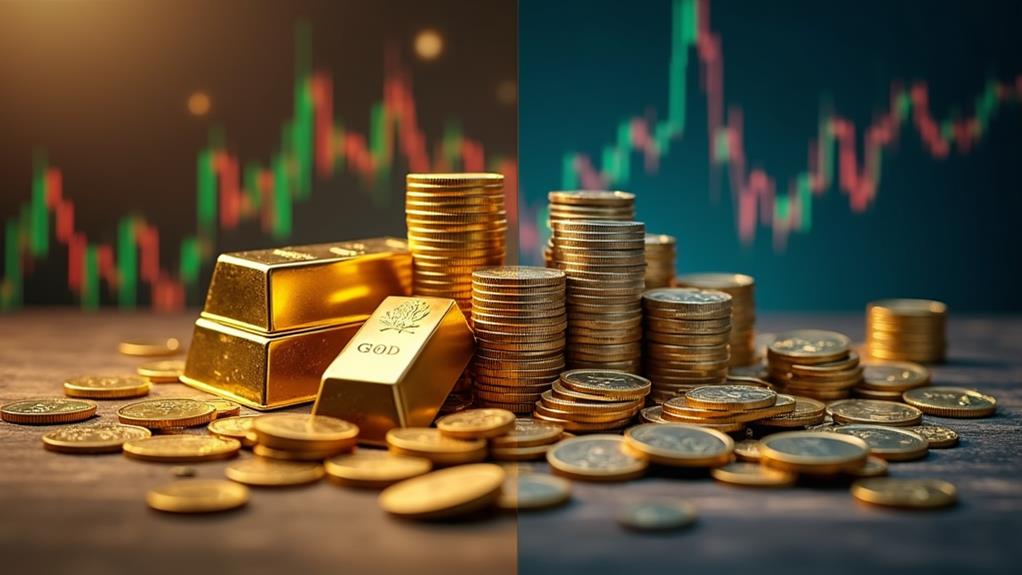
When comparing investment strategies, it becomes clear that Peter Schiff's approach is distinctively centered on the fundamental value of precious metals like gold and silver. His gold investment recommendations advocate allocating 5-10% of portfolios to physical metals, emphasizing wealth preservation during inflation. Peter Schiff's investing in gold approach also includes investing in gold mining companies and related stocks, as well as utilizing gold as a hedge against currency devaluation and geopolitical instability. This strategy sets him apart from more traditional investment approaches that focus on stocks, bonds, and real estate. Schiff's emphasis on the intrinsic value of gold aligns with his belief in the long-term stability and growth potential of precious metals.
SchiffGold highlights gold's finite nature, positioning it as a stable asset compared to volatile real estate, which has appreciated significantly. Schiff's investment strategies for gold focus on its long-term value as a hedge against economic uncertainty, contrasting it with less secure traditional investments during financial crises. Gold also emphasizes the importance of diversifying one's portfolio with gold, as it can protect against inflation and currency devaluation. The firm's gold investment strategy from Peter Schiff includes advising clients to allocate a portion of their assets to physical gold and considering gold mining stocks for potential growth. Focusing on long-term wealth preservation, SchiffGold's approach to gold investment aligns with Peter Schiff's belief in the metal's enduring value.
His guidance on gold vs. fiat currency underscores gold's reliability, particularly during market turmoil, ensuring tailored, transparent, and competitive transactions for investors.
Our Final Thoughts
Peter Schiff's advocacy for gold investment, particularly allocating 5-10% of a portfolio to physical precious metals, offers a strategic long-term wealth preservation and diversification approach. Given gold's historical stability and potential for appreciation amid high inflation and economic uncertainties, Schiff's stance presents a compelling case. Nevertheless, investors should consider the associated risks and compare various investment strategies to ensure a balanced and well-informed decision-making process.