Peter Schiff gold investment strategy allocates a substantial portion of his portfolio to precious metals, posing a compelling alternative to conventional investment practices. Schiff's prediction of gold reaching $5,000 per ounce stems from his belief that economic instability and currency devaluation require a hedge only gold can provide. By advocating for global diversification and physical gold ownership, this approach offers a method to mitigate market volatility. Gold investment tips for 2024 from Peter Schiff also include the recommendation to prioritize long-term holding and to avoid speculative trading. Schiff advises investors to maintain a balanced portfolio by incorporating other asset classes, such as real estate and foreign equities, alongside gold. With his proven track record in predicting economic trends, Schiff's gold investment strategy provides a roadmap for preserving wealth in a turbulent financial landscape.
How does Schiff's strategy compare to traditional investment methods, and what are the practical implications for investors? Let's examine these intriguing aspects further to understand this unconventional approach's potential benefits and risks.
Our Quick Summary
- Schiff allocates approximately 50% of his portfolio to gold and silver mining stocks for growth and protection.
- Physical gold is emphasized as a hedge against economic instability and currency devaluation.
- Geographic diversification outside the U.S. is a core principle, focusing on reliable dividend payouts.
- Based on historical economic crises, Schiff predicts gold prices could reach $5,000 per ounce.
- He highlights secure vault storage for physical gold to mitigate counterparty and liquidity risks.
Peter Schiff's Background

Peter Schiff, the CEO of Euro Pacific Asset Management, is a well-known financial commentator renowned for his contrarian investment philosophy, which prominently features precious metals.
Influenced by the Austrian School of Economics, Peter Schiff‘s gold investment philosophy advocates for sound money principles, emphasizing savings and capital investment for wealth creation.
Approximately 50% of his stock portfolio comprises gold and silver mining stocks, including major companies like Barrick Gold and Newmont Corporation.
Schiff posits that gold prices could reach $5,000 per ounce or higher, viewing it as a hedge against economic collapse and currency devaluation.
His precious metals investment strategy also involves portfolio diversification outside the U.S., focusing on reliable dividend payouts from foreign stocks.
Key Principles of Schiff's Strategy
Understanding Peter Schiff's background sets the stage for examining the vital principles underpinning his investment strategy.
Schiff's gold investment strategy is rooted in several fundamental principles:
- Inflation Hedge: He views physical gold as a safeguard against economic instability and currency devaluation.
- Gold Mining Stocks: His portfolio allocation heavily features gold and silver mining stocks, like Barrick Gold and Newmont Corporation, which account for about 50% of his holdings.
- Global Diversification: Influenced by the Austrian School of Economics, Schiff believes in diversifying outside the U.S. for growth opportunities.
- Historical Trends: Past economic crises, such as the 2008 financial collapse, informed his focus on precious metals.
- Reliable Dividends: Schiff likewise values foreign stocks with dependable dividend payouts, complementing his precious metals investments.
Schiff's Strategy Vs. Others
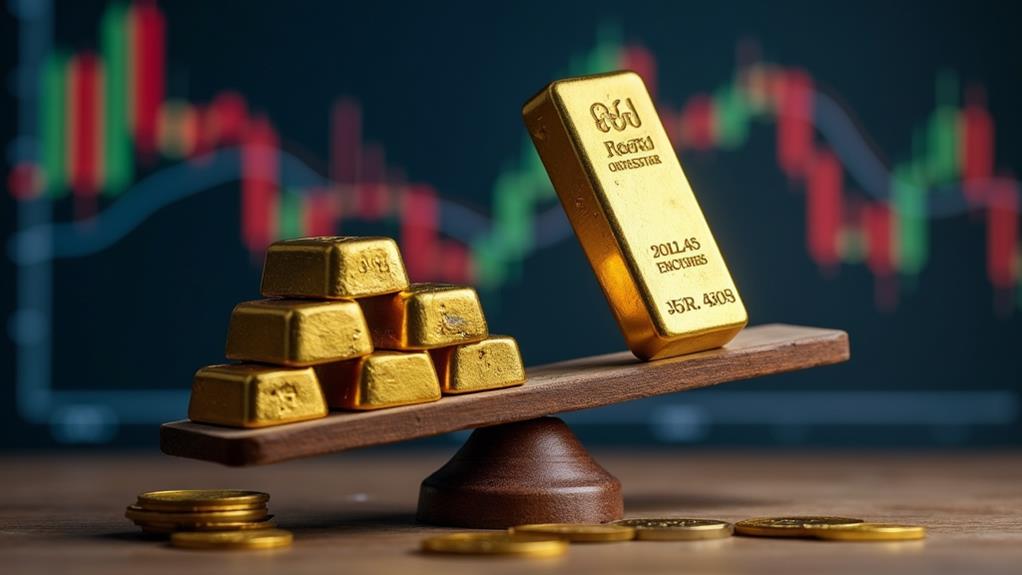
Comparing Schiff's investment strategy to others uncovers significant divergences in approach and underlying philosophy. Schiff's heavy emphasis on gold and silver, comprising roughly 50% of his portfolio, contrasts sharply with traditional diversification strategies focused on growth equities. While many investors see gold investment risks, Schiff views gold as a safe haven asset, crucial during economic instability and currency devaluation.
| Aspect | Peter Schiff | Traditional Investors |
|---|---|---|
| Primary Focus | Gold & silver mining stocks | Diversified equities |
| Gold Price Predictions | $5,000 per ounce or higher | Moderate growth expectations |
| Geographic Diversification | Foreign stocks (e.g., Nestlé) | Mainly domestic stocks |
| Performance During Growth | Underperforms | Benefits from bull markets |
Schiff's contrarian stance, driven by inflation fears and financial instability, sets him apart from mainstream strategies.
Gold in a Diversified Portfolio
Incorporating gold into a diversified portfolio offers a hedge against economic uncertainty and a strategic means of mitigating risks associated with domestic downturns.
Peter Schiff's investment strategy exemplifies this approach. He allocates a significant portion of his portfolio to gold and silver mining stocks while advocating for physical gold ownership. When asked about his reasoning for this strategy, Schiff often highlights the potential for inflation and economic instability, which has historically increased precious metals' value. He believes that owning physical gold provides a hedge against these potential risks. Due to his expertise in the field, many investors seek gold investment advice from Peter Schiff as they navigate the complexities of the market.
This method underscores the importance of precious metals as a reliable store of value and a safeguard against market volatility.
Diversification With Precious Metals
Integrating precious metals such as gold into a diversified investment portfolio offers a strategic hedge against economic uncertainty and currency devaluation.
Peter Schiff's approach to gold investment education highlights the importance of asset protection, particularly through physical gold and mining stocks. Schiff capitalizes on gold supply and demand dynamics and gold market trends by allocating a significant portion of his portfolio to companies like Barrick Gold and Newmont Corporation.
Gold's Role as Hedge
While economic landscapes continually shift, gold's role as a hedge in a diversified portfolio remains a resolute strategy for mitigating risk.
Peter Schiff allocates approximately 50% of his stock portfolio to gold and silver mining stocks, underscoring his conviction in gold's potential to counter economic uncertainty.
By possessing physical gold, investors can safeguard their wealth against currency devaluation and inflation, preserving long-term value.
Historically, gold has served as a reliable store of value during geopolitical tensions and economic downturns, reinforcing Schiff's advocacy for including precious metals as safe havens in investment portfolios.
This approach, emphasizing gold as a hedge, aims to mitigate market volatility and economic instability risks.
Benefits of Physical Gold

Physical gold offers numerous advantages for shrewd investors, primarily as a hedge against economic uncertainty.
With physical gold storage, investors can secure tangible assets like gold bullion, safeguarding their wealth from gold price volatility and economic downturns.
Peter Schiff advocates for gold as it retains purchasing power, especially during inflation or currency devaluation.
Gold in a recession proves its value, providing liquidity and wealth transfer options when needed.
Additionally, the flexibility of investing in gold coins or bars caters to diverse financial goals.
Schiff predicts significant price appreciation, potentially reaching $5,000 per ounce, making physical gold a strong investment amid fiscal instability.
Its accessibility and historical stability underscore its strategic importance.
Risks of Gold ETFs
Despite the strategic advantages of holding physical gold, investors may similarly consider exchange-traded funds (ETFs) as a convenient alternative.
Nonetheless, investing in a gold ETF carries certain risks.
- Counterparty risk: The security of the underlying assets depends on the trustworthiness of the fund's custodian.
- Market timing: ETFs can underperform in volatile markets due to tracking errors.
- Liquidity risks: During market downturns, selling ETF shares at desired prices may be challenging.
- Management fees: These fees can erode returns, particularly in stagnant or declining gold markets.
These factors require careful consideration when evaluating gold ETFs as part of an investment strategy.
Buying and Storing Gold

When contemplating gold investment, owning physical gold offers distinct advantages, particularly as a hedge against economic uncertainty.
Employing secure vault storage options, such as those provided by SchiffGold, ensures your assets remain safe and accessible.
Furthermore, diversifying your portfolio by including precious metals like gold can improve long-term value and stability in your investment strategy.
Physical Gold Ownership Benefits
Owning physical gold offers investors a reliable hedge against economic uncertainty, as advocated by financial expert Peter Schiff.
Physical gold ownership bypasses counterparty risks fundamental in paper assets, ensuring a tangible asset with essential value. Schiff emphasizes purchasing gold coins and bars, verifying their authenticity and purity for resale.
- Hedge Against Inflation: Gold often retains value when fiat currencies depreciate due to central bank policies.
- Portfolio Diversification: Including gold in investment strategies for gold reduces overall risk.
- Tangible Asset: Unlike stocks or bonds, physical gold is a tangible asset that can be held.
- Economic Stability: Gold provides a safeguard during financial instability, contrasting sharply with fiat currency volatility.
These elements underscore the strategic value of owning physical gold.
Secure Vault Storage Options
Having established the benefits of physical gold ownership, attention must be given to the secure storage of this valuable asset.
Secure vault storage is a cornerstone of Peter Schiff's gold investment strategy, designed to safeguard against theft and market volatility. SchiffGold offers a range of vault storage options, including allocated and unallocated solutions, to provide flexibility tailored to investors' needs.
These facilities employ rigorous security measures and regular audits to maintain the integrity of gold holdings. By choosing secure vault storage, investors can ensure the safety of their assets while maintaining gold market liquidity.
SchiffGold's storage services offer peace of mind, making them a crucial component of a strong gold investment strategy.
Diversifying Precious Metals Holdings
Peter Schiff advocates diversifying precious metals holdings as a wise strategy to mitigate economic uncertainty and improve investment portfolios.
Schiff's gold investment strategy underscores the importance of holding physical gold, which is complemented by an allocation to gold and silver mining stocks.
Schiff advises considering various storage options, such as private vaults and secure home safes, to ensure safety and accessibility.
Understanding the gold supply chain and demand drivers is essential in making informed investment decisions.
Schiff furthermore highlights the value of junk silver for liquidity during economic downturns.
- Allocate 50% of the stock portfolio to mining stocks.
- Invest in physical precious metals directly.
- Use private vaults or secure home safes for storage.
- Stay informed on market fundamentals and geopolitical influences.
Economic Predictions and Strategy
Forecasting the future trajectory of gold prices, Peter Schiff suggests that values could surge to $5,000 per ounce or even higher, spurred by fears of currency devaluation and persistent economic instability.
Peter Schiff's gold investment strategy hinges on the belief that physical gold is a critical hedge against inflation and fiscal irresponsibility. Peter Schiff's approach to gold investing is seen as a way to protect wealth from the devaluation of paper currency. He also believes that gold is a safe haven during times of economic uncertainty and geopolitical instability. Schiff advocates for allocating a portion of an investor's portfolio to physical gold as a long-term strategy for preserving wealth and hedging against potential financial risks.
In times of a global economic crisis, Schiff allocates about 50% of his stock portfolio to gold and silver mining stocks, seeking reliable dividends and growth potential.
His contrarian approach, grounded in the Austrian School of economics, advocates for sound money principles and emphasizes diversification to mitigate domestic risks.
Schiff's analysis underscores the correlation between geopolitical risks and precious metal prices, reinforcing gold's role in gold trading strategies.
Performance and Controversies

Peter Schiff's gold investment strategy, characterized by a significant allocation to gold and silver mining stocks, has been lauded and criticized within the financial community. Some experts believe that Schiff's heavy investment in precious metals is a strong hedge against inflation and economic uncertainty, while others argue that it exposes his portfolio to unnecessary risk. Regardless of the debate, many investors seek gold investment insights from Peter Schiff, recognizing his expertise in the precious metals market. Ultimately, the success of Schiff's strategy will depend on the mining industry's performance and the broader economic landscape.
Schiff's forecasts of substantial gold price increases, potentially reaching $5,000 per ounce, underscore his belief in gold's resilience against economic instability and currency devaluation.
Despite gold's recent 4% price increase, contrasting with Bitcoin's downturn, Schiff's strategy faces scrutiny for underperforming during U.S. economic growth and bull markets.
Critics argue that his narrow focus on gold, often at the expense of U.S. stocks and broader diversification, exposes his portfolio to significant risks.
- Gold IRA: Employed for tax-advantaged retirement savings.
- Historical Gold Performance: Reflects gold's resilience over time.
- Capital Appreciation: Potential for long-term gains.
- Deflationary Pressures: Hedge against economic downturns.
Our Final Thoughts
In summary, Peter Schiff's gold investment strategy, characterized by a significant allocation to precious metals and a focus on global diversification, presents a compelling case for gold as a hedge against economic instability and currency devaluation. Emphasizing the benefits of physical gold ownership and secure storage, Schiff's approach contrasts with traditional investment strategies, offering a unique perspective on portfolio diversification. While not without risks, this strategy highlights the potential for significant returns during economic uncertainty.