The debate between Peter Schiff vs experts on gold and mainstream financial experts favoring cryptocurrencies like Bitcoin raises compelling questions about the future of safe-haven assets. Schiff's unwavering belief in gold investment as a hedge against inflation and economic turmoil, despite his unfulfilled predictions of gold soaring to $5,000 per ounce, contrasts sharply with the rising enthusiasm for digital currencies.
As economic conditions evolve, this discourse highlights a significant moment in investment strategy. What implications does this clash of perspectives have for diversified portfolios and long-term financial security?
Our Quick Summary
- Peter Schiff correctly predicted the 2008 financial collapse, bolstering his credibility in advocating for gold investment.
- Gold has a historical record of preserving value during economic uncertainty and inflation, reinforcing Schiff's stance.
- Schiff's predictions of gold reaching $5,000 per ounce remain unfulfilled, raising skepticism among mainstream economists.
- Gold's average annual return historically outpaces inflation, supporting its role as a hedge against economic instability.
- Bitcoin's dramatic gains and emerging popularity challenge Schiff's advocacy for gold, suggesting a shift towards cryptocurrencies in investment strategies.
Peter Schiff's Background

Peter Schiff's background in economics and financial commentary is marked by his unwavering advocacy of gold as a hedge against inflation and economic instability. Peter Schiff's gold investment advocacy is grounded in his belief that the precious metal's intrinsic value and limited supply make it an ideal safeguard for wealth preservation. He has often warned against the potential risks of fiat currency and the dangers of government intervention in the economy, urging individuals to allocate a portion of their portfolios to physical gold. Schiff's consistent message has resonated with many investors, leading them to consider gold as a cornerstone of their financial strategy.
As the founder of Euro Pacific Capital, Schiff has built a career promoting the importance of varying investments into hard assets, particularly precious metals.
His reputation as one of the leading precious metals experts was cemented when he correctly predicted the 2008 economic collapse, showcasing his contrarian stance on fiat currencies.
Through his books, such as “Crash Proof: How to Profit From the Coming Economic Collapse,” Schiff outlines his gold investment philosophy, emphasizing gold's long-term value.
Regularly debating mainstream financial experts, Schiff remains a staunch proponent of gold despite the prevailing focus on stock market investments.
Schiff's Gold Bull Reputation
Building on his background and expertise in economics, Schiff's reputation as a gold bull is characterized by his unwavering belief in gold's inherent value as a safe-haven asset.
He frequently argues that inflation and central bank policies, which he views as detrimental to fiat currencies, make gold a superior long-term investment.
In the ongoing debate of “Peter Schiff vs. gold experts,” Schiff's gold price predictions often include striking forecasts, such as gold reaching $5,000 per ounce.
His critiques of government monetary policy bolster his standing among investors seeking strong gold investment strategies.
Schiff's consistent advocacy has fostered a dedicated community of gold advocates, emphasizing gold's historical role as a reliable store of value during economic instability.
Gold as Inflation Hedge

Gold has long been heralded as a strong hedge against inflation, with historical evidence underscoring its ability to maintain value during rising consumer prices.
Gold has proven effective as an inflation hedge, evidenced by a 30% gain over five years during economic volatility. During inflationary periods, investors often turn to precious metals as a safe haven, as gold retains value better than devalued fiat currencies.
The correlation between gold prices and inflation rates is notable, with significant price surges during past inflationary crises.
Historical gold performance shows that, despite fluctuations, gold has consistently outpaced inflation over the long term.
Gold investment trends demonstrate that economic uncertainty and rising inflation expectations drive increased demand, safeguarding purchasing power.
Predictions for Gold Prices
Considering historical price trends, market sentiment analysis, and future price drivers, the predictions for gold prices present a compelling narrative.
Peter Schiff's projections suggest that gold could reach between $5,000 and $10,000 per ounce, gaining traction when considering gold's performance during past economic crises and its current resilience at around $1,900 per ounce.
As economic forecasts signal potential inflation and sustained loose monetary policies, historical and contemporary factors lend credence to a bullish outlook on gold, aligning with Schiff's predictions.
Historical Price Trends
Examining the historical price trends of gold uncovers a narrative of significant volatility, with notable peaks and troughs shaping its market perception.
Gold price volatility is evident from its peak of around $1,900 per ounce in 2011, followed by a decline to approximately $1,050 by late 2015. This fluctuation underscores the intrinsic risks of gold investment in its market.
Historical performance shows a modest 30% gain over five years, contrasting sharply with Bitcoin's 375% surge, thus highlighting differing long-term potentials.
Market analysis suggests external economic factors like inflation and market volatility drive gold demand as a safe-haven asset.
Nevertheless, changing investor preferences, especially toward cryptocurrencies, raise questions about gold's future price trajectory.
Market Sentiment Analysis
While historical price trends disclose gold's characteristic volatility, current market sentiment provides a subtle understanding of potential future price movements.
Macroeconomic factors, including economic uncertainty, inflation rates, and geopolitical tensions, strongly influence market sentiment around gold. Analysts often observe gold market trends to gauge future price directions, mainly through monetary policy impact and gold price speculation.
For example, the correlation between gold prices and the US dollar is critical, as a weaker dollar tends to support higher prices.
- Macroeconomic factors: Inflation rates, geopolitical tensions.
- Historical performance: Approximately 30% gain over five years.
- Monetary policy impact: Interest rate fluctuations.
- Inflation persistence: Potential rally above $2,000 per ounce.
- Currency correlation: Significant relationship with the US dollar.
Future Price Drivers
Anticipating future price movements in the gold market requires carefully analyzing several critical drivers.
Crucial gold demand drivers include economic indicators like inflation rates; higher inflation tends to increase gold's appeal as a hedge.
Interest rates and gold are closely linked. Lower rates reduce the opportunity cost of holding gold, potentially driving prices higher.
Geopolitical risks and economic uncertainties often lead to a surge in gold investments, as seen during crises.
Furthermore, disruptions in the supply chain, such as mining challenges, can create scarcity, pushing prices upward.
Supporting Evidence for Gold

Peter Schiff contends that gold's historical performance underscores its reliability as a hedge against inflation and economic turbulence.
For example, gold's value surged during the 2008 financial crisis, significantly outperforming other asset classes.
Moreover, gold's appreciation of approximately 30% over the past five years highlights its stability compared to more volatile investments like cryptocurrencies.
Historical Gold Performance
Gold's historical performance underscores its enduring appeal as a reliable investment. The price of gold, nearing $2,000 per ounce in August 2020, exemplifies its role as a safe haven during economic uncertainty. Over the past five years, gold has yielded a return of approximately 30%, showcasing its stability compared to more volatile assets like cryptocurrencies.
Before the COVID-19 pandemic, gold was around $1,700 per ounce, demonstrating its resilience during crises.
Key factors influencing gold performance include:
- Gold as a hedge: Historically, it rises during high inflation.
- Supply and demand: Impacted by mining output and central bank purchases.
- Economic indicators: Fluctuations reflect economic health.
- Crisis response: Peaks during economic turmoil.
- Long-term stability: Consistent returns over time.
These elements reinforce gold's status as a dependable investment.
Gold's Inflation Hedge
Numerous empirical studies and historical data confirm gold's efficacy as a hedge against inflation, illustrating its value preservation capabilities during economic turbulence.
Gold bullion has consistently shown an ability to maintain long-term value preservation, particularly during periods of currency devaluation. For example, gold prices surged over 25% during the 2008 financial crisis, highlighting its role as a safe-haven asset.
The average annual return on gold has historically outpaced inflation, making it a reliable store of value. Gold investment strategies often recommend allocating 5-10% of a diversified portfolio to gold, especially in low-interest-rate environments.
Gold's fundamental value, less volatile than fiat currencies, underscores its significance in mitigating inflation risks.
Contrasting Expert Opinions
A growing schism in investment strategies has become apparent as experts weigh in on the merits of gold versus cryptocurrencies.
Peter Schiff's gold investment recommendations emphasize its historical value and effectiveness as a hedge during economic downturns.
Conversely, many expert opinions highlight Bitcoin's impressive 375% gain over five years, dwarfing gold's 30% rise.
This debate includes:
- Gold's role as a tangible asset during a recession
- Bitcoin's volatility versus gold's stability
- The potential for Bitcoin to surpass $100,000
- Schiff's skepticism about Bitcoin's sustainability
- The shift in investment strategies favoring cryptocurrencies
Gold vs. other assets remains a focal point, with Schiff arguing for its reliability, while others predict transformative growth in cryptocurrencies.
Schiff's Prediction Accuracy

Peter Schiff's track record in predicting gold prices and economic events has drawn acclaim and criticism. As of October 2023, his forecasts of fiat currency decline and gold price surges, such as gold reaching $5,000 per ounce, remain unmet.
Despite his insights into potential global economic crises, Schiff's gold trading strategies have often faced skepticism from mainstream economists due to gold's modest 30% rise over the past five years. Many experts also point to the fact that gold has underperformed compared to other investment vehicles, such as stocks and real estate, over the same period. However, staunch supporters of gold investing from Peter Schiff argue that this overlooks gold's long-term value and stability as a hedge against inflation and economic uncertainty. They believe that Schiff's approach to gold trading considers these broader economic trends, which may not be reflected in short-term price fluctuations.
While Schiff's economic insights emphasize gold market liquidity as a hedge against inflation, his timing has often been inaccurate. This contrasts with more substantial gains observed in Bitcoin investments.
Consequently, Schiff's prediction accuracy, particularly concerning gold prices, has been debated among financial experts. Moreover, some analysts argue that Schiff's gold predictions have been overly bearish, failing to account for the long-term potential of the precious metal. On the other hand, Schiff's supporters laud his foresight in warning about the 2008 financial crisis and believe that his gold predictions are rooted in a deep understanding of global economic trends. Despite the conflicting opinions, Schiff predictions for gold continue to garner attention and analysis from investors and financial professionals alike.
Risks of Schiff's Advice
Critics argue that Schiff's unwavering promotion of gold as a primary investment vehicle fails to account for the significant long-term returns demonstrated by Bitcoin, which has outperformed gold by a considerable margin over the past five years.
Relying solely on gold can expose investors to several risks, including:
- Gold supply and demand: Market dynamics can fluctuate, impacting gold prices unpredictably.
- Capital appreciation: Bitcoin's substantial gains suggest potential missed opportunities for higher returns.
- Diversification strategy: Overconcentration in gold may neglect the benefits of a varied portfolio.
- Counterparty risk: Physical gold storage and transactions can entail additional risks.
- Market trends: Ignoring emerging trends like cryptocurrencies can result in outdated investment approaches.
Adopting a balanced strategy could mitigate these risks and improve overall investment performance.
Gold in Diversified Portfolios
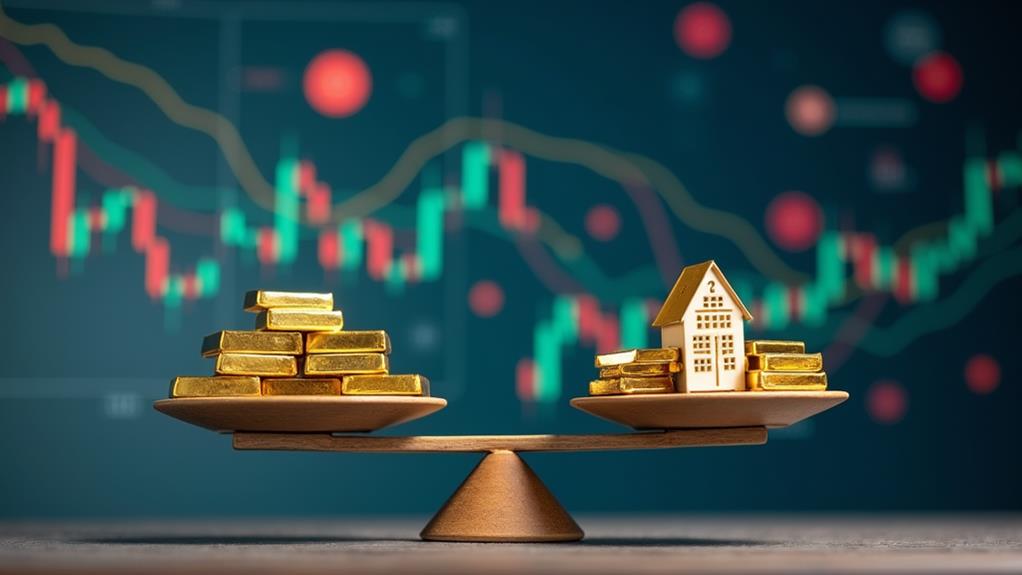
One cannot overlook the strategic importance of including gold in a diversified investment portfolio. Gold bars, mining stocks, and ETFs can provide crucial diversification.
Gold's low correlation with other asset classes mitigates overall portfolio risk, acting as a hedge against inflation and economic instability. Over the past five years, gold has gained 30%, showcasing stability compared to the volatility of cryptocurrencies like Bitcoin.
Financial experts advocate for a 5% to 10% allocation to gold, which balances returns without significant risk. During financial crises, gold often serves as a safe haven, with its price rising as investor confidence in traditional markets diminishes.
This makes gold an effective counterbalance within a wise investment horizon.
Our Final Thoughts
In summary, the debate between Peter Schiff and mainstream experts underscores the intricacies of investment strategies in fluctuating economic climates. Despite his unfulfilled price predictions, Schiff's unwavering advocacy for gold highlights its historical stability and role as an inflation hedge. Contrarily, proponents of cryptocurrencies argue for their potential and innovation. Investors must weigh the historical evidence supporting gold against the speculative nature and volatility of digital currencies, considering both traditional and emerging assets in diversified portfolios.